Shopping for health insurance can feel like walking into a store where everything has a different price tag, nobody explains the rules, and somehow you’re supposed to know which deal is best.
Then somebody tells you to buy through the Health Insurance Marketplace. Somebody else says private insurance is better. And before you know it, you’re wondering whether you’re comparing two completely different kinds of insurance.
Well, here’s the thing: sometimes you’re not.

So before you spend your hard-earned money, let’s look at what really separates these options and how to spot a good deal without getting fooled by a low price.
First, What Is the Health Insurance Marketplace?
The Health Insurance Marketplace is a service that helps individuals and families compare and enroll in health insurance plans.
Most states use HealthCare.gov , while some states operate their own official marketplaces.
Here’s something important: the government doesn’t necessarily provide the insurance itself. Private insurance companies offer the plans sold through the Marketplace.
That’s right. You can purchase coverage from a private insurance company through the government Marketplace.
Marketplace plans must meet Affordable Care Act (ACA) requirements, including coverage for essential health benefits and protections for pre-existing conditions.
The Marketplace also checks whether you’re eligible for premium tax credits, certain cost-sharing reductions, or programs such as Medicaid and CHIP.
So What Does “Private Health Insurance” Mean?
Here’s where the confusion starts.
Private health insurance isn’t one specific product. It’s insurance offered by private companies.
When people say they’re buying private insurance outside the Marketplace, they might mean:
- An ACA-compliant individual plan purchased directly from an insurance company.
- An ACA-compliant plan purchased through an agent or broker.
- A short-term medical policy with more limited coverage.
- A fixed-indemnity or supplemental insurance product.
And baby, those are not all the same thing.
A comprehensive ACA-compliant plan purchased directly from an insurer can offer the same essential protections as a Marketplace plan.
But some other products marketed as private health coverage may cover far less.
Marketplace vs. Private Plans: The Real Comparison
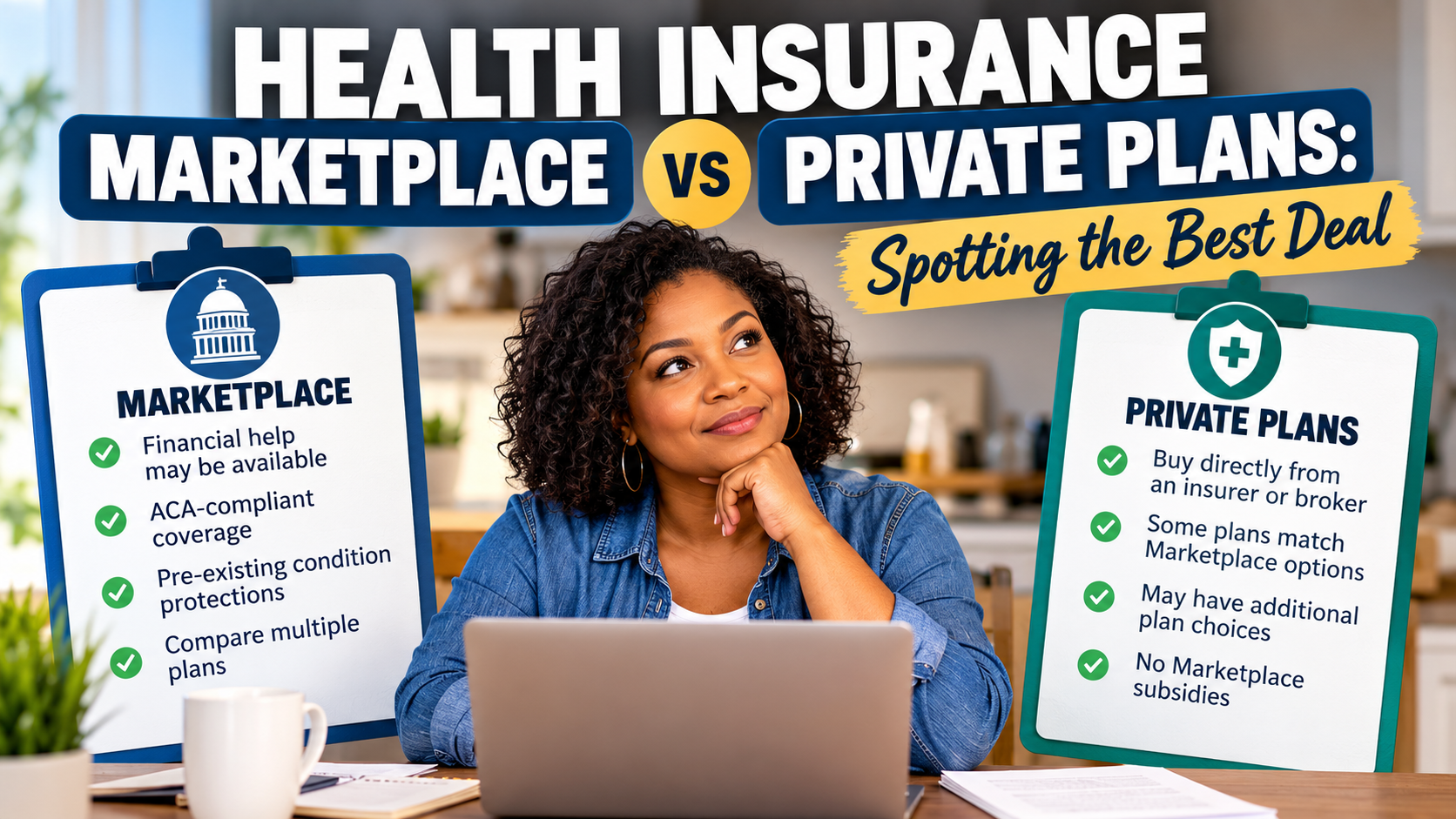
Let’s compare Marketplace coverage with comprehensive ACA-compliant coverage purchased outside the Marketplace.
| What to Compare | Marketplace Plan | ACA-Compliant Plan Bought Outside |
|---|---|---|
| Who sells it? | Private insurers through the Marketplace | Private insurers through direct sales or brokers |
| Premium tax credits | Available if eligible | Not available for off-Marketplace enrollment |
| Pre-existing conditions | ACA protections apply | ACA protections apply |
| Essential health benefits | Required | Required for ACA-compliant individual plans |
| Doctor networks | Depend on the specific plan | Depend on the specific plan |
| Enrollment timing | Usually Open Enrollment or a qualifying Special Enrollment Period | Generally similar timing for ACA-compliant individual coverage |
| Available plans | Plans listed on your Marketplace | May include additional off-Marketplace choices |
So no, buying outside the Marketplace doesn’t automatically get you a better product.
And buying through the Marketplace doesn’t mean you’re getting government-run health insurance.
The Biggest Money Difference: Subsidies
This is where I want you to pay close attention.
If you’re eligible for a premium tax credit, it can reduce what you pay each month for Marketplace coverage.
Your eligibility depends on factors such as household income, family size, tax circumstances, and access to other qualifying coverage.
Financial assistance rules can change from one coverage year to the next, so don’t assume that last year’s savings will be the same this year.
That’s why checking Marketplace savings should usually be one of your first steps.
And here’s another important detail: you can get assistance from a licensed, Marketplace-registered agent or broker and still receive eligible Marketplace savings, as long as your enrollment goes through the Marketplace or an approved enrollment partner.
You don’t necessarily have to do the entire process by yourself.
What About the Doctors and Hospitals?
Now let’s talk about a mistake that can cost you more than you expected.
You find an affordable plan. The monthly premium looks good. You sign up.
Then you discover your doctor isn’t in the network.
Oh, now we’ve got a problem.
Whether a plan comes from the Marketplace or directly from an insurance company, you need to check its provider network.

Two plans from the same insurance company may have different networks.
Before enrolling, verify:
- Your primary care doctor
- Your preferred hospital
- Any specialists you regularly see
- Your prescription medications and pharmacies
- Whether referrals are required
- How out-of-network care is handled
Don’t just ask, “Do you take this insurance company?” Ask whether the provider accepts the exact plan and network you’re considering.
Watch Out for Plans That Look Cheaper Because They Cover Less
Here’s where a bargain can turn into a headache.
You see an advertisement promising health coverage for a surprisingly low monthly price.
It looks like insurance. It sounds like insurance. But what exactly are you buying?
Some products sold outside the Marketplace are not comprehensive ACA-compliant health insurance.
Short-Term Health Insurance
Short-term policies are designed for temporary coverage. Depending on the policy and applicable state rules, they may exclude pre-existing conditions or important categories of medical care.
Fixed-Indemnity Plans
These policies generally pay a specified dollar amount for certain covered events or services.
For example, a policy might pay a set amount for a hospital stay, even if the actual hospital bill is much larger.
These products can serve supplemental purposes, but they are not the same as comprehensive major medical insurance.
Discount Programs and Health Sharing Arrangements
A discount membership is not the same thing as insurance. And healthcare sharing arrangements generally do not provide the same contractual protections as regulated health insurance.
If the person selling it can’t give you a clear answer and a Summary of Benefits and Coverage when applicable, that’s a reason to slow down.
How to Spot the Best Deal: My Simple Comparison Method
You don’t need to compare twenty different policies to get started.
Narrow it down to two or three serious contenders, then follow these steps.
- Check your Marketplace eligibility first. Find out whether you qualify for premium tax credits, cost-sharing reductions, Medicaid, or CHIP.
- Get the actual monthly price. Compare the premium after any eligible Marketplace financial assistance, not just the advertised full price.
- Compare the annual premium cost. Multiply the monthly premium by 12. That tells you how much you’ll pay to maintain coverage for a full year.
- Look at deductibles and out-of-pocket limits. A low premium can come with substantial costs when you need care.
- Check doctors and medications. A plan isn’t a bargain if the care you need isn’t accessible or affordable.
- Verify the type of coverage. Make sure you’re comparing comprehensive health plans rather than accidentally comparing one with a limited-benefit product.
- Read the official plan documents. Look at the Summary of Benefits and Coverage, exclusions, network information, and drug formulary.
A Practical Budget Test
Ask yourself two questions:
1. Can I comfortably pay this premium every month?
2. If I needed significant medical care this year, could I manage the plan’s potential out-of-pocket expenses?
The best deal isn’t necessarily the plan with the lowest price. It’s the plan that offers the most appropriate coverage for your needs at a cost you can manage.
Which Route Makes More Sense for You?
Start With the Marketplace If…
- You may qualify for financial assistance.
- You want to compare ACA-compliant plans.
- You need comprehensive individual or family coverage.
- You want to check eligibility for Medicaid or CHIP.
Consider Off-Marketplace ACA Plans If…
- You know you don’t qualify for Marketplace savings.
- You want to compare additional ACA-compliant options.
- A specific off-Marketplace plan has a network or benefit design that better fits your needs.
- You understand that income-based Marketplace savings won’t apply to an off-Marketplace purchase.
Neither route is automatically the winner. The right choice depends on your eligibility, the available plans, your healthcare needs, and the actual total cost.
Can You Sign Up Any Time?
Not necessarily.
Comprehensive ACA-compliant individual health insurance generally follows Open Enrollment and Special Enrollment Period rules.
Qualifying life events, such as losing certain health coverage, getting married, or having a baby, may allow enrollment outside the regular window.
Medicaid and CHIP applications are generally accepted year-round.
Be careful if someone tells you a comprehensive ACA plan is available to anyone at any time, without checking enrollment eligibility.
You can review current enrollment information at HealthCare.gov .
Frequently Asked Questions
Is Marketplace insurance the same as private insurance?
Marketplace plans are offered by private insurance companies. Some insurers also sell ACA-compliant plans outside the Marketplace. The enrollment route and financial assistance eligibility may differ.
Can a broker help me get Marketplace subsidies?
Yes. A licensed, Marketplace-registered agent or broker can help you enroll with eligible savings, provided the enrollment is completed through the Marketplace or an approved enrollment pathway.
Is private health insurance always cheaper?
No. Off-Marketplace ACA plans don’t qualify for Marketplace premium tax credits. Some cheaper products also provide less comprehensive coverage. Always compare both benefits and total costs.
Do ACA-compliant private plans cover pre-existing conditions?
Yes. ACA-compliant individual major medical plans must follow federal protections for pre-existing conditions. Not every product marketed as private health coverage is ACA-compliant.
Should I choose Marketplace or private coverage if I’m self-employed?
Start by checking Marketplace eligibility and financial assistance. Then compare available comprehensive off-Marketplace plans if appropriate. Self-employment alone does not prevent you from qualifying for Marketplace coverage.
The Bottom Line
Here’s what I want you to take away from all this.
Don’t get caught up in somebody telling you that Marketplace insurance is always better or that private insurance is always cheaper.
Sometimes you’re comparing different enrollment routes for very similar coverage.
Other times you’re comparing a comprehensive health insurance plan with something that doesn’t provide nearly the same protection.
Those are two very different situations.
Check your savings eligibility. Compare the actual benefits. Verify your doctors and prescriptions. And read what the policy does not cover.
Because saving a few dollars today shouldn’t mean getting stuck with thousands in unexpected medical expenses tomorrow.
Need Help Comparing Health Insurance Options?
At Just 4 My Family, we’re here to help make health insurance easier to understand.
Explore your options and take the next step toward coverage that fits your needs and your budget.
Explore Health Insurance OptionsNew to Health Insurance?
If terms like deductibles, copays, and coinsurance still sound confusing, start with our beginner’s guide.
Helpful Official Resources
- HealthCare.gov — Official Health Insurance Marketplace
- Find Marketplace Enrollment Assistance
- What Marketplace Plans Cover
And remember: life happens. Be prepared, stay protected, and always put your family first.
Disclaimer: This article is for general educational purposes and is not a guarantee of insurance eligibility, benefits, pricing, or coverage. Plan availability and financial assistance rules vary by state, household, coverage year, and individual circumstances. Always review official plan documents before enrolling.