
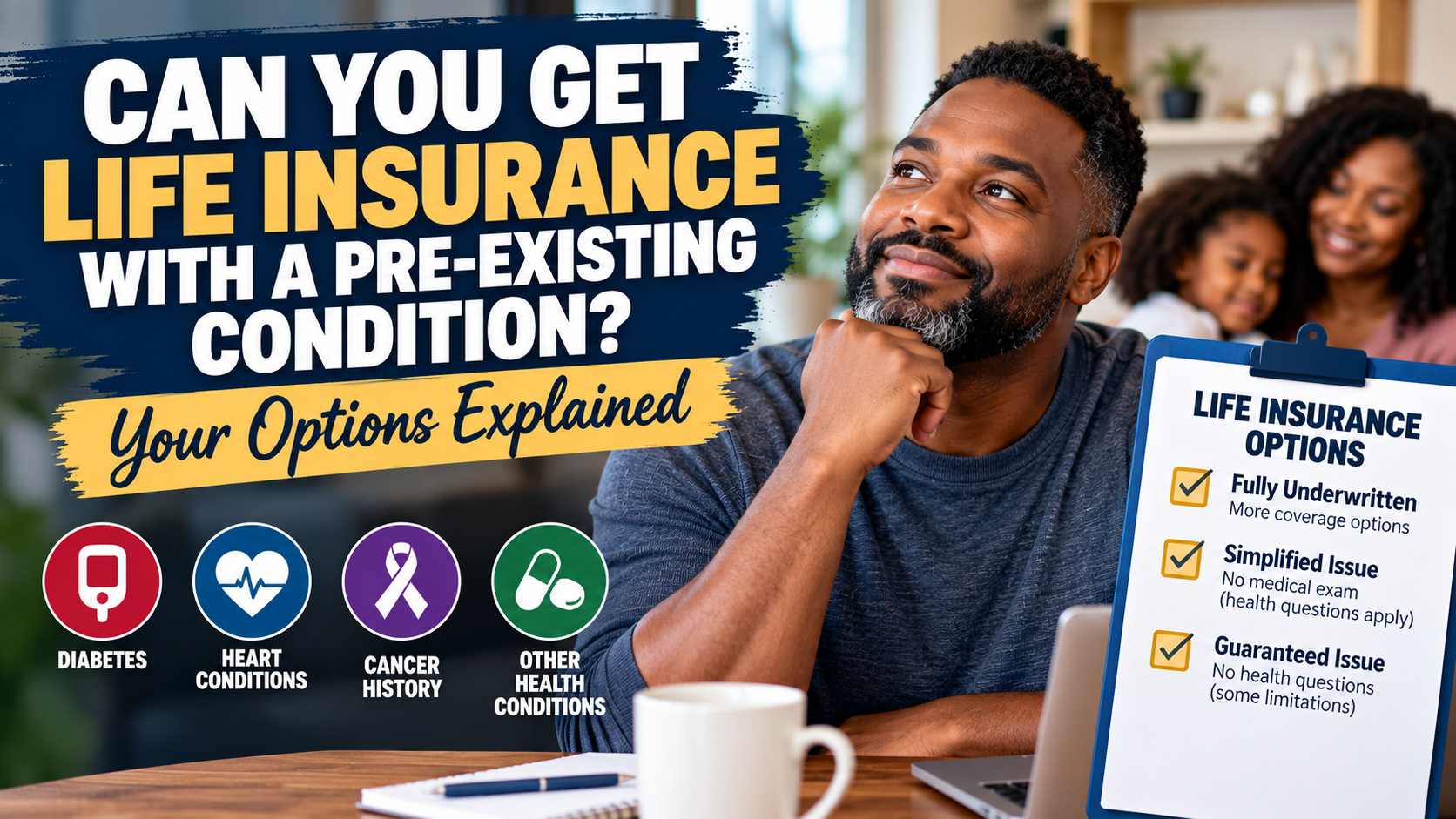
You’ve got diabetes. Or maybe you’ve had a heart attack, survived cancer, or take medication for a chronic condition. And somewhere along the way, somebody made you believe that life insurance was completely out of the question.
Well, honey, don’t count yourself out before you’ve even explored your options.
Having a pre-existing medical condition does not automatically mean you cannot qualify for life insurance. It may affect the type of policy available, the premium you’ll pay, or whether an insurer approves your application. But there are different ways to apply.
Today we’re going to talk about those options, what insurance companies may look at, and how to take the next step without wasting time applying for the wrong kind of coverage.

What Is a Pre-existing Condition in Life Insurance?
A pre-existing condition is a health issue you already have or have been diagnosed with before applying for coverage.
Examples include:
- Type 1 or Type 2 diabetes
- High blood pressure
- Heart disease or a previous heart attack
- A history of cancer
- Asthma or chronic lung conditions
- Kidney disease
- Autoimmune disorders
- Depression or other mental health conditions
Insurers don’t necessarily treat every diagnosis the same way.
Someone with well-managed high blood pressure may have very different options from someone who recently experienced a major medical event.
That’s why your diagnosis is only part of the story.
What Insurance Companies Actually Look At
Life insurance underwriting is the process an insurer uses to evaluate an application and decide whether to offer coverage, at what price, and under what terms.
Depending on the policy, the company may consider:
- Your age
- Your specific diagnosis
- When the condition began
- Whether it is stable or progressing
- Your medications and treatment history
- Recent hospitalizations or surgeries
- Any complications or related conditions
- Your smoking or nicotine history
- Your overall health and medical records
Some insurers may request laboratory results, physician records, or a medical examination. Others use health questions and electronic records.
And some policies are designed to accept eligible applicants without evaluating their medical history.
Three Ways to Apply for Life Insurance
Before you start filling out applications, understand these three basic underwriting routes.
1. Fully Underwritten
A more detailed review of your health. May include medical records, an exam, and laboratory testing.
Worth exploring when: Your condition is stable and you need meaningful coverage.
2. Simplified Issue
Usually no medical exam, but health questions and other underwriting checks still apply.
Worth exploring when: You want a simpler application and meet the product’s health requirements.
3. Guaranteed Issue
Generally no health questions or medical exam, subject to eligibility requirements such as age and state availability.
Worth exploring when: Other types of coverage are difficult to qualify for.
Fully Underwritten Life Insurance
This is the traditional route many people think about when shopping for life insurance.
It may take more time and require more medical information, but it can be worth considering before assuming you need a more limited policy.
Some applicants with well-managed health conditions may qualify for coverage, although they might pay a higher premium than someone without those conditions.
Simplified-Issue Life Insurance
Now here’s where people sometimes get confused.
No medical exam does not mean no underwriting.
A simplified-issue application may still ask whether you’ve been diagnosed with certain conditions, hospitalized recently, or received specific treatments.
The insurer may also check prescription history or other permitted records.
So you can still be declined.
But depending on your medical history, it may be another option worth reviewing.
Guaranteed-Issue Life Insurance
Guaranteed-issue life insurance generally does not require a medical exam or health questions for eligible applicants.
That can be helpful when someone has serious health challenges.
But there are important trade-offs.
- Coverage amounts are often smaller.
- Premiums may be higher for the amount of coverage.
- Age restrictions usually apply.
- Some policies have a graded death benefit period.
Which Option Might Fit Your Health History?
Let’s look at a few common situations. These examples are general starting points, not promises of approval.
| Health Situation | What to Explore First |
|---|---|
| Well-managed high blood pressure | Traditional or accelerated underwriting |
| Controlled diabetes without major complications | Traditional underwriting, then simplified issue if appropriate |
| Previous heart attack | Individual review based on recovery, treatment, and current health |
| Cancer in remission | Individual review based on cancer type, stage, treatment, and time since treatment |
| Active serious illness or repeated declines | Review simplified-issue eligibility and guaranteed-issue alternatives |
Can You Get Life Insurance With Diabetes?
Yes, some people with diabetes can qualify for life insurance.
Insurers may consider the type of diabetes, how long you’ve had it, your treatment, recent blood sugar control, and whether you have complications.
For example, someone whose diabetes is consistently managed may be evaluated differently from someone with serious kidney or cardiovascular complications.
Taking medication does not automatically disqualify you. But it is important to disclose your diagnosis and treatment accurately.
What If You’ve Had a Heart Attack?
A previous heart attack can make underwriting more complicated, but it does not necessarily mean every option is unavailable.
An insurer may want to know when the event occurred, what treatment you received, whether you’ve had additional cardiac problems, and how your heart is functioning now.
A recent event may lead to a postponement or decline under certain products. Someone with a longer, stable recovery history may have different options.
This is a situation where an individualized review can be especially valuable.
What About Life Insurance After Cancer?
If you’ve survived cancer, first of all, you’ve already been through a lot.
And you deserve accurate information about your insurance options, not somebody making assumptions about your future.
Life insurance underwriting after cancer often depends on the cancer type, stage, treatment received, whether treatment is complete, and the length of remission.
Some applicants may qualify for traditionally underwritten coverage after an appropriate period. Others may need to consider different policy types.
There is no single waiting period that applies to every cancer history or insurer.
Don’t Assume Guaranteed Issue Is Always Your Best Option
I want to make this point because it’s important for your budget.
Just because a policy says “no medical exam” or “guaranteed acceptance” doesn’t mean it’s automatically the best value.
If you qualify for a traditionally underwritten policy, you may be able to obtain more coverage for your premium than you would through a guaranteed-issue product.
On the other hand, guaranteed issue may be worth considering when other coverage is unavailable.
The key is comparing your actual options, not choosing based on advertising alone.

What Happens If You’ve Already Been Denied?
Now listen, being denied life insurance can feel discouraging.
But one denial doesn’t automatically mean every insurer will make the same decision.
Here’s what to do next:
- Find out why. Ask what information contributed to the decision and how to request relevant records or reports.
- Check for errors. If an underwriting report contains inaccurate information, find out how to dispute it.
- Review your current health information. Updated treatment records or test results may help clarify your situation.
- Consider a different underwriting route. Another product may use different eligibility criteria.
- Ask about an informal review. A licensed insurance professional may be able to discuss your general history with an insurer before a formal application, depending on the carrier’s process.
Five Mistakes to Avoid When Applying
1. Hiding a Medical Condition
Always answer application questions truthfully and completely. Material misrepresentations can create serious problems with coverage or claims.
2. Applying for the First Policy You See
Different policy types have different eligibility rules. Understand the product before submitting an application.
3. Assuming No Exam Means Guaranteed Approval
Simplified-issue coverage usually still involves health questions and underwriting.
4. Ignoring the Waiting Period
Ask when the full death benefit becomes payable and whether any graded benefit provisions apply.
5. Buying More Than You Can Afford
A policy only helps your family if you can reasonably maintain the required premium payments.
Questions to Ask Before Buying
- Will I need a medical exam?
- Will the insurer ask health questions?
- Does the policy have a graded death benefit?
- What happens if I die during the first two years?
- How much is the monthly premium?
- Can the premium increase later?
- How long will coverage remain in force?
- Are there exclusions or other limitations?
- How much money would my beneficiaries receive?
And please don’t be embarrassed to ask for an explanation in plain English.
You should understand what you’re buying before you sign anything.
Frequently Asked Questions
Can I get life insurance if I take prescription medications?
Possibly. Insurers may consider why the medication is prescribed, your underlying condition, and your overall health. Medication use alone does not automatically mean you will be declined.
Is there life insurance without a medical exam?
Yes. Some accelerated and simplified-issue products do not require an exam. However, health questions or electronic underwriting checks may still apply. Guaranteed-issue policies generally skip both exams and health questions for eligible applicants.
Can I get life insurance with several health conditions?
It depends on the conditions, their severity, your overall health, and the specific policy. If traditional coverage isn’t available, other underwriting routes may be worth exploring.
Will a pre-existing condition make life insurance more expensive?
It can. Insurers may charge higher premiums when an applicant presents greater underwriting risk. Pricing varies by company, policy, and applicant.
Does guaranteed issue mean my family receives the full benefit immediately?
Not necessarily. Many guaranteed-issue policies have a graded death benefit period for death from natural causes. Review the exact terms and exceptions before buying.
The Bottom Line: Don’t Count Yourself Out
If you have diabetes, heart disease, a cancer history, or another chronic condition, don’t assume life insurance is automatically out of reach.
Your health history matters, but so does the type of policy you’re considering.
You may qualify for traditional coverage. You may need a simplified-issue option. Or guaranteed issue may be a more realistic alternative.
What matters is understanding the differences, reviewing the limitations, and choosing something your family can actually depend on.
Because the purpose of life insurance isn’t to win somebody’s approval. It’s to help provide financial protection for the people you love.
Let’s Explore Your Life Insurance Options
Have a pre-existing condition and aren’t sure where to start?
Just 4 My Family can help you begin exploring available life insurance options based on your needs, budget, and circumstances.
Request Life Insurance InformationRequesting information does not guarantee approval or coverage.
Keep Learning
Want help understanding how to choose a policy before you apply?
Helpful Resources
And remember: life happens. Be prepared, stay protected, and always put your family first.
Disclaimer: This article provides general educational information. It is not an offer of insurance or a guarantee of eligibility. Underwriting, rates, waiting periods, exclusions, and policy availability vary by insurer, product, state, and applicant. Review official policy documents and consult a licensed insurance professional before making a purchasing decision.