
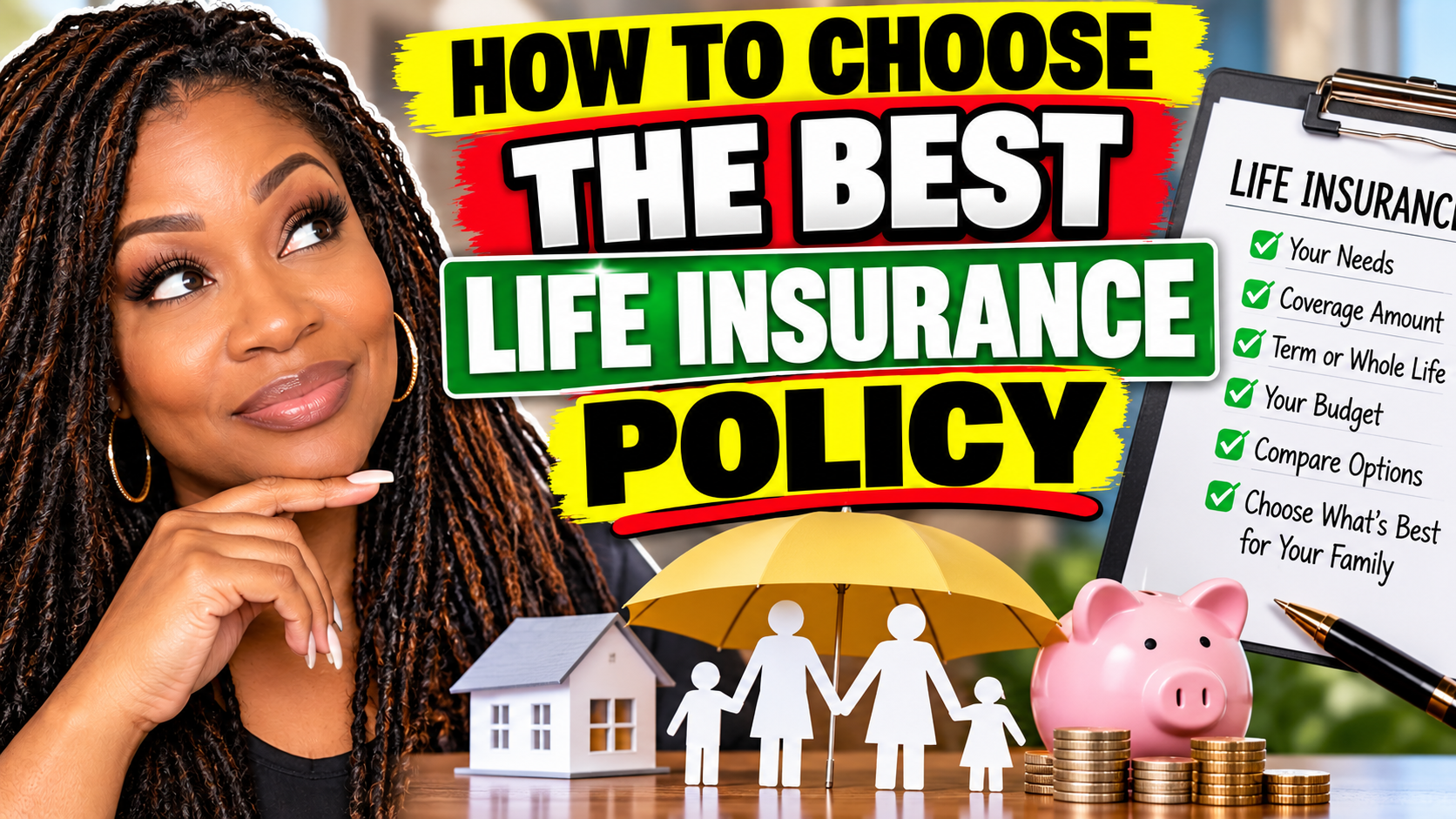
Choosing life insurance can get confusing fast. One company is talking about term life. Another is showing you whole life. Then you hear about universal life, cash value, riders and policy loans. So how do you figure out which life insurance policy is actually right for you?
The answer starts with something that often gets overlooked: why you need life insurance in the first place.
There isn’t one life insurance policy that’s automatically best for every person. A policy that makes sense for a parent with young children and a 25-year mortgage may be completely different from what makes sense for someone whose children are grown and whose main concern is final expenses.
Watch the video above for my explanation, then use this guide to help you think through the questions you should consider before choosing coverage.
Why do you need life insurance, and who are you trying to protect?
1. Start With Why You Need Life Insurance
Before comparing companies or asking how much a policy costs, identify the financial problem you’re trying to solve.
For example, are you trying to make sure your spouse can continue paying the mortgage? Do you have children who depend on your income? Are you concerned about funeral and final expenses? Do you want to leave money behind for your children or grandchildren?
Your answer matters because different financial needs may require different amounts and lengths of coverage.
- Replacing lost household income
- Paying off or helping with a mortgage
- Providing for dependent children
- Paying outstanding debts
- Covering funeral and final expenses
- Leaving money to beneficiaries
- Providing long-term or permanent protection
If you’re still learning the basics, read What Is Life Insurance? before moving on.
2. Decide How Long You Need Coverage
This is one of the biggest factors when deciding between term and permanent life insurance.
⏳ Term Life Insurance
Term life insurance provides coverage for a specific period, such as 10, 20 or 30 years.
It generally provides more death-benefit protection for the premium dollar, particularly during the earlier years of coverage.
Term can make sense when you’re protecting a temporary financial responsibility such as a mortgage, dependent children or income during your working years.
🛡️ Permanent Life Insurance
Permanent life insurance is designed to provide longer-term or lifetime protection as long as the policy requirements are met.
Whole life, universal life and variable life are examples of cash-value policies.
Depending on the policy, permanent insurance can also accumulate cash value that may be accessible during your lifetime.
Neither option is automatically better. The question is which one better matches your need, your timeline and your budget.
For a deeper comparison, see Term vs. Whole Life Insurance: Which Is Right for You?
3. Figure Out How Much Life Insurance You Need
Don’t pick a coverage amount simply because $100,000, $250,000 or $500,000 sounds like a lot of money.
Think about what would financially happen to your household if your income disappeared tomorrow.
You can also read How Much Life Insurance Coverage Does a Parent Need?
4. Choose a Premium You Can Actually Afford
This part is extremely important.
Buying an expensive policy doesn’t necessarily mean you’ve bought a better policy.
If the premium eventually becomes unaffordable and the policy lapses, the coverage may no longer be there when your family needs it.
That’s why affordability should be part of the decision from the beginning.
5. Understand What’s Guaranteed and What Isn’t
This becomes particularly important when you’re considering permanent life insurance.
Some policy illustrations may contain both guaranteed and non-guaranteed values. Don’t assume every number shown in an illustration is guaranteed to occur.
- Which benefits are guaranteed?
- Can my premium increase?
- Does this policy build cash value?
- How quickly could the cash value grow?
- Are any illustrated values non-guaranteed?
- What happens if I miss premium payments?
- What could cause the policy to lapse?
- Are there surrender charges?
6. Don’t Choose Whole Life Just Because You Can Borrow From It
Cash value can be an attractive feature of permanent life insurance, but policy loans need to be understood correctly.
A policy loan is not free money. Interest generally accrues on the amount borrowed, and outstanding loans can reduce the amount ultimately available to beneficiaries.
If you’re interested in this feature, read my guide on how whole life insurance premiums and cash value work.
7. Compare Similar Policies Before Making a Decision
Price matters, but it shouldn’t be the only thing you compare.
Look at the type of coverage, length of coverage, death benefit, guarantees, riders, conversion options, cash-value provisions where applicable, and the insurer itself.
Two policies with the same death benefit can work very differently.
8. Be Careful Before Replacing an Existing Policy
If you already have life insurance, don’t automatically cancel it because someone shows you another policy.
Your existing coverage may have features, pricing or guarantees that would be difficult or more expensive to replace today. Your age and health may also affect what new coverage is available.
So, What Is the Best Life Insurance Policy?
The best life insurance policy isn’t necessarily the one with the biggest death benefit, the lowest advertised price or the most features.
It’s the policy that appropriately addresses the financial risk you’re trying to protect against while remaining affordable enough for you to maintain.
Start with these four questions:
How MUCH coverage do I need?
How LONG do I need it?
What can I comfortably AFFORD?
Once you know those answers, comparing life insurance becomes much easier.
Frequently Asked Questions
What type of life insurance is best for most families?
There isn’t one type that’s best for every family. Term insurance can be appropriate when a family needs substantial protection for a specific period, while permanent insurance can be appropriate when lifetime protection or cash-value features are important. Your financial needs, age, health, goals and budget all matter.
Is term life insurance better than whole life?
Not automatically. Term and whole life solve different problems. Term provides coverage for a defined period and generally costs less initially. Whole life is designed for lifetime coverage and can accumulate cash value, but premiums are generally higher.
How much life insurance should I buy?
Consider your income, mortgage and debts, dependents, final expenses, future financial obligations and resources your family already has. The appropriate amount is personal rather than a single number that works for everyone.
Should I buy the cheapest life insurance policy?
Price is important, but it shouldn’t be your only consideration. Compare the policy type, term, benefits, guarantees, exclusions, insurer and whether the coverage actually meets your needs.
Can I have more than one life insurance policy?
It is possible to own more than one life insurance policy, subject to underwriting and the insurer’s limits. Some people use different policies to address different financial needs.
Still Not Sure Which Policy Is Right for You?
You don’t have to figure everything out by yourself. I can help you look at your coverage goals, budget and available options so you can make an informed decision for your family.
GET YOUR FREE PERSONALIZED QUOTELife happens. Be prepared. Stay protected. Always put your family first.
This article is for general educational purposes and is not a guarantee of coverage, premium, policy performance or underwriting outcome. Policy features, availability and requirements vary by insurer and state.