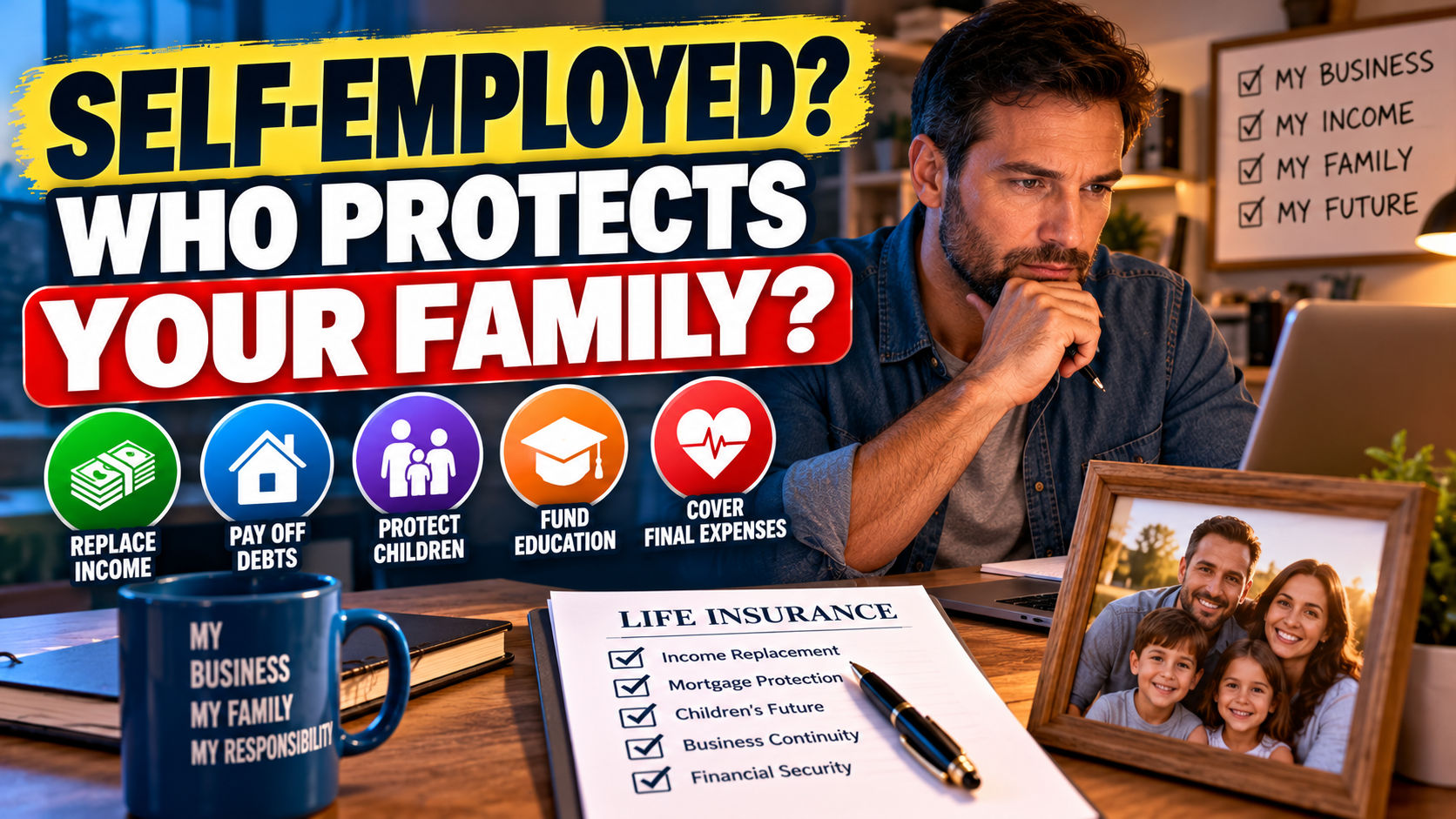
Being your own boss sounds wonderful, doesn’t it?
No supervisor watching the clock. No asking permission to take a vacation. No somebody scheduling a meeting that could have been an email.
But here’s the part people don’t talk about enough.
When you’re self-employed, you’re not just the employee. You’re the employer, the benefits department, and sometimes the entire business.
That means if something happens to you, there’s no guarantee that a company-sponsored life insurance policy is waiting to help your family.
And if your household depends on the money you bring in, that’s a risk worth thinking about.
Whether you’re a hairstylist, truck driver, rideshare driver, real estate agent, freelancer, consultant, or small-business owner, let’s talk about how life insurance can help protect the people who depend on you.
Self-Employed Financial Protection
Your Business Supports Your Family.
Who Protects Them If You’re Gone?
Build a financial safety net that doesn’t depend on an employer.
1. Why Self-Employed People Need to Think Differently About Life Insurance
When you work for a traditional employer, you may receive benefits such as group life insurance, disability coverage, paid leave, or retirement contributions.
Not every employer offers those benefits, and employer life insurance is often limited. But at least some employees have a starting point.
When you’re self-employed, you generally have to arrange those protections yourself.
And here’s the thing: your family’s bills don’t care whether you’re working a nine-to-five or running your own business.
The mortgage is still due.
The car payment is still due.
The grocery bill is definitely still coming.
If you died unexpectedly, life insurance could provide a death benefit to your beneficiaries to help cover financial needs.
That money might help your loved ones:
- Replace income your household relied on.
- Continue paying housing and living expenses.
- Pay certain outstanding debts.
- Cover childcare or educational expenses.
- Pay funeral and final expenses.
- Buy time to make decisions about your business.
Unlike an employer benefit that may end when you leave a job, an individually owned policy can remain in force as long as you satisfy its terms, including required premium payments.
Want the basics first? Read What Is Life Insurance and How Does It Work?
2. Your Business Income Isn’t the Same as a Guaranteed Paycheck
Let’s say you’re a self-employed hairstylist earning money from appointments.
When you work, you earn.
When clients cancel, business slows down.
And if you’re no longer there to perform those services, the income may disappear.
The same can happen with freelancers, consultants, contractors, and other owner-operated businesses.
Some businesses can continue generating revenue without the owner. Others depend almost entirely on that person’s time, expertise, or relationships.
That’s why your life insurance decision should consider more than how much money you made last month.
Ask yourself:
- How much of our household income comes from my work?
- Would my business continue operating without me?
- Could my spouse or partner cover our expenses alone?
- Do I have children or other dependents?
- Are there business debts or personal guarantees?
- How long would my family need financial support?
Important distinction: Life insurance generally pays a death benefit when the insured person dies under the policy’s terms. It does not replace income simply because business is slow, you lose clients, or you become unable to work. Disability insurance is designed to address certain qualifying disabilities that interrupt earnings.
3. How Much Life Insurance Does a Self-Employed Person Need?
You’ve probably heard somebody say you need life insurance equal to 10 times your income.
That’s a common rule of thumb, but self-employment makes the calculation a little more interesting.
One month you might earn $4,000. Another month you might earn $9,000. And let’s not forget the business expenses that have to come out of that money.
Instead of automatically multiplying your best month by 12, start with a realistic picture of your household finances.
Start With Your Actual Household Needs
Consider these categories:
- Income replacement: How much money does your family need each year, and for how many years?
- Housing: Would you want to help pay off a mortgage or provide money for rent?
- Debts: Which obligations would remain for your family or estate?
- Children: What would childcare, school, and future education cost?
- Final expenses: What amount would help with funeral and immediate costs?
- Existing resources: What savings, investments, or insurance benefits are already available?
Example: A Self-Employed Parent
Imagine a self-employed contractor whose household depends on approximately $60,000 of annual income from the business.
After reviewing the family’s expenses, they estimate the following needs:
| Financial Need | Amount |
|---|---|
| 10 years of income replacement | $600,000 |
| Additional education savings | $75,000 |
| Final expenses and transition costs | $25,000 |
| Total estimated need | $700,000 |
| Existing savings and coverage | -$100,000 |
| Estimated additional coverage | $600,000 |
Illustrative example only. It does not account for every financial factor, such as inflation, investment returns, taxes, or all household expenses. Avoid counting the same expense twice.
In this example, the family might explore around $600,000 in additional coverage.
But that doesn’t mean every self-employed person needs $600,000.
Your number should reflect your household, not somebody else’s example.
For more help with coverage calculations, visit How Much Life Insurance Coverage Does a Parent Need?
4. Term Life vs. Whole Life: Which Makes Sense When You’re Self-Employed?
Let’s break down two common options.
Term Life Insurance
Provides coverage for a specified period, such as 10, 20, or 30 years.
Generally costs less initially than whole life for the same death benefit.
Typically does not accumulate cash value.
May fit: Self-employed people who need substantial protection while raising children, paying a mortgage, or building savings.
Whole Life Insurance
Designed to provide lifelong coverage as long as required premiums are paid.
Generally costs more than term insurance for the same death benefit.
Builds cash value under the policy’s terms.
May fit: People with long-term insurance needs who can comfortably maintain the premiums.
For many self-employed people on a variable income, term life insurance is a useful starting point because it may provide a larger death benefit for a more manageable initial premium.
But permanent coverage can make sense in some situations.
The right choice depends on your goals, budget, and how long you need coverage.
Read Term vs. Whole Life: Which Is Right for You? for a more detailed comparison.
5. What About Universal Life and Indexed Universal Life?
Self-employed people sometimes hear about universal life insurance, including indexed universal life (IUL), as another option.
These are forms of permanent life insurance that may offer adjustable premiums or death benefits within policy limits.
Indexed universal life policies generally credit interest using a formula tied to an external market index, subject to policy terms such as caps, participation rates, and floors. The policy is not the same as investing directly in that index.
Here’s what matters:
Flexible premiums do not mean you can stop paying indefinitely without consequences.
Policy charges continue, and insufficient funding or poor performance relative to illustrations may cause a policy to lapse.
Permanent policies can also involve surrender charges, loans, and other complexities.
For someone with inconsistent business income, it’s especially important to understand what premiums may be required to keep coverage active over time.
Learn more in IUL Explained: How Indexed Universal Life Insurance Really Works.
6. Can You Get Life Insurance With Irregular or 1099 Income?
Yes. Being self-employed does not automatically prevent you from qualifying for life insurance.
You don’t necessarily need a traditional W-2 job.
However, insurers may review financial information to determine whether the coverage amount is appropriate.
Depending on the company and application, that might include:
- Your occupation and type of business.
- Annual income or business earnings.
- How long you’ve been self-employed.
- Recent tax returns or other financial records.
- Existing life insurance coverage.
- The reason for the amount of insurance requested.
Not every application requires the same documentation.
For larger coverage amounts, financial underwriting may be more detailed.
If your income changes from year to year, explain your situation accurately and ask what documentation the insurer accepts.
7. What If You Own a Business With Employees or Partners?
Now we’re getting into a different part of life insurance planning.
If you’re a sole proprietor who works alone, your main concern may be protecting your family’s finances.
But if you have employees, business partners, or a company that depends heavily on your leadership, you may have additional needs.
Key Person Life Insurance
A business may purchase life insurance on an owner or essential employee, with appropriate consent and legal requirements, to help protect the company from financial disruption if that person dies.
The business generally owns the policy and receives the proceeds.
This is different from personally owned life insurance intended to support your spouse or children.
Buy-Sell Agreements
If you own a business with a partner, a properly structured buy-sell agreement may help determine what happens to ownership if one partner dies.
Life insurance is sometimes used to help fund the purchase of a deceased owner’s interest.
These arrangements require careful legal, tax, and insurance planning.
Business Loans and Personal Guarantees
Some business owners personally guarantee business debts.
If you have personally guaranteed a loan, it’s worth understanding what obligations could remain after your death.
Life insurance may be part of the financial plan, but whether a particular debt becomes an estate or survivor obligation depends on the agreement and applicable law.
Business owner reminder: Personal life insurance, key person coverage, and buy-sell funding serve different purposes. Don’t assume one policy automatically solves all three problems.
8. Life Insurance Won’t Protect Your Paycheck If You Become Disabled
Here’s an important distinction that self-employed workers should understand.
Let’s say you run your own cleaning business.
You injure your back and can’t work for several months.
Your life insurance generally isn’t going to pay you simply because you’re unable to clean houses.
That’s where disability insurance may come into the conversation.
Disability insurance may replace a portion of eligible earnings if you meet the policy’s definition of disability and other requirements.
Business overhead expense insurance may help pay certain eligible business operating expenses during a qualifying disability, depending on the policy.
Some life insurance policies also offer riders with additional benefits, but those riders are not substitutes for understanding your overall income-protection needs.
Think of it this way:
Life insurance: Helps protect beneficiaries financially after an insured person’s death.
Disability insurance: May help replace income during a qualifying disability.
Emergency savings: Helps cover temporary interruptions and unexpected expenses.
Those are three different tools, and self-employed households may benefit from considering all three.
9. How Much Does Life Insurance Cost When You’re Self-Employed?
Here’s some good news.
Being self-employed does not automatically mean your life insurance will cost more than someone else’s.
Insurers typically consider factors such as:
- Age
- Health and medical history
- Tobacco or nicotine use
- Occupation and certain occupational hazards
- Coverage amount
- Policy type and term length
- Other underwriting considerations
For example, a self-employed graphic designer and a salaried graphic designer with otherwise similar risk profiles may receive comparable rates.
But a business involving hazardous work may be evaluated differently.
Your actual price depends on the insurer and your individual circumstances.
And because business income can fluctuate, remember to choose a premium you can realistically maintain during slower months.
10. Can You Deduct Life Insurance Premiums as a Business Expense?
This is a question many self-employed people ask.
In general, premiums for a personally owned life insurance policy protecting your family are not deductible simply because you’re self-employed.
Business-owned policies have their own tax rules. For example, federal tax law generally restricts deductions when a business is directly or indirectly a beneficiary of a life insurance policy.
There can be additional rules involving employer-owned life insurance, notice and consent requirements, and taxation of proceeds.
Don’t purchase a policy assuming you’ll receive a tax deduction.
Talk with a qualified tax professional about your specific business structure and arrangement.
11. Five Life Insurance Mistakes Self-Employed People Should Avoid
Mistake #1: Assuming Your Business Will Take Care of Your Family
Some businesses have value that survives their owner. Others don’t. Know which situation applies to you.
Mistake #2: Buying Coverage Based Only on Your Best Income Year
Use realistic financial information and your family’s actual needs.
Mistake #3: Choosing Premiums You Can’t Maintain
A policy doesn’t help your family if it lapses because the payments become unaffordable.
Mistake #4: Confusing Life Insurance With Disability Insurance
Death benefits and disability income benefits address different risks.
Mistake #5: Never Reviewing Your Coverage
Your business, income, debts, and family responsibilities can change significantly over time.
For more warning signs, read Life Insurance Red Flags: What to Watch Out For.
12. Your Self-Employed Life Insurance Checklist
☐ Calculate the income your household depends on.
☐ Review mortgage, debt, and childcare obligations.
☐ Estimate how long your family would need financial support.
☐ Subtract appropriate savings and existing coverage.
☐ Compare term and permanent life insurance options.
☐ Choose a premium that fits your variable income.
☐ Review beneficiary designations.
☐ Consider separate disability income protection.
☐ Review business ownership and succession needs.
☐ Revisit coverage after major life or business changes.
Frequently Asked Questions About Life Insurance for the Self-Employed
Can I get life insurance if I’m self-employed?
Yes. Self-employed people can apply for life insurance. Eligibility, available coverage amounts, and rates depend on the insurer’s underwriting requirements.
Do I need proof of income to buy life insurance?
Not always. Some applications may require little or no financial documentation, while others—particularly those involving larger death benefits—may require income verification or financial records.
Is term life insurance good for freelancers?
Term life insurance may be a practical option for freelancers who need affordable coverage for a specific period, such as while raising children or paying off a mortgage.
Does life insurance cover lost income if my business closes?
No. Traditional life insurance generally does not pay benefits because a business closes or income declines. It is primarily designed to pay a death benefit when the insured person dies under covered circumstances.
Can a business own a life insurance policy?
Yes, in certain arrangements. Business-owned life insurance may be used for key person protection or succession planning, subject to insurable interest, consent, tax, and other legal requirements.
Can I keep my life insurance if I change careers?
An individually owned policy generally remains in effect if you meet its terms and continue required payments. Check the policy and insurer rules for any relevant provisions.
The Bottom Line: When You’re the Boss, You Have to Think Like the Benefits Department Too
There’s something powerful about building your own business.
You’re creating opportunities for yourself instead of waiting for somebody else to hand them to you.
But independence comes with responsibility.
And one of those responsibilities is making sure the people who depend on your income have a financial safety net.
You work hard for your business.
You work hard for your family.
Don’t overlook protecting the people you’re working so hard for.
Because being your own boss shouldn’t mean your family has to face financial uncertainty alone.
Self-Employed? Let’s Explore Your Life Insurance Options.
At Just 4 My Family, I help individuals and families understand life insurance options without unnecessary confusion or pressure.
Whether you’re a freelancer, independent contractor, gig worker, or small-business owner, let’s look at coverage that fits your family’s needs and your budget.
Request a Life Insurance QuoteNo obligation. Availability, pricing, and approval depend on insurer underwriting and policy terms.
More Life Insurance Resources
- What Is Life Insurance?
- Term vs. Whole Life Insurance
- How to Choose the Best Life Insurance Policy
- Is Employer-Provided Life Insurance Enough?
- Indexed Universal Life Insurance Explained
For additional consumer information, visit the National Association of Insurance Commissioners.
And remember: life happens. Be prepared, stay protected, and always put your family first.
Disclaimer: This article is for general educational purposes and does not constitute individualized insurance, financial, legal, or tax advice. Life insurance coverage, premiums, benefits, exclusions, and underwriting requirements vary by company and state. Business-related insurance arrangements should be reviewed with appropriate insurance, legal, and tax professionals.