
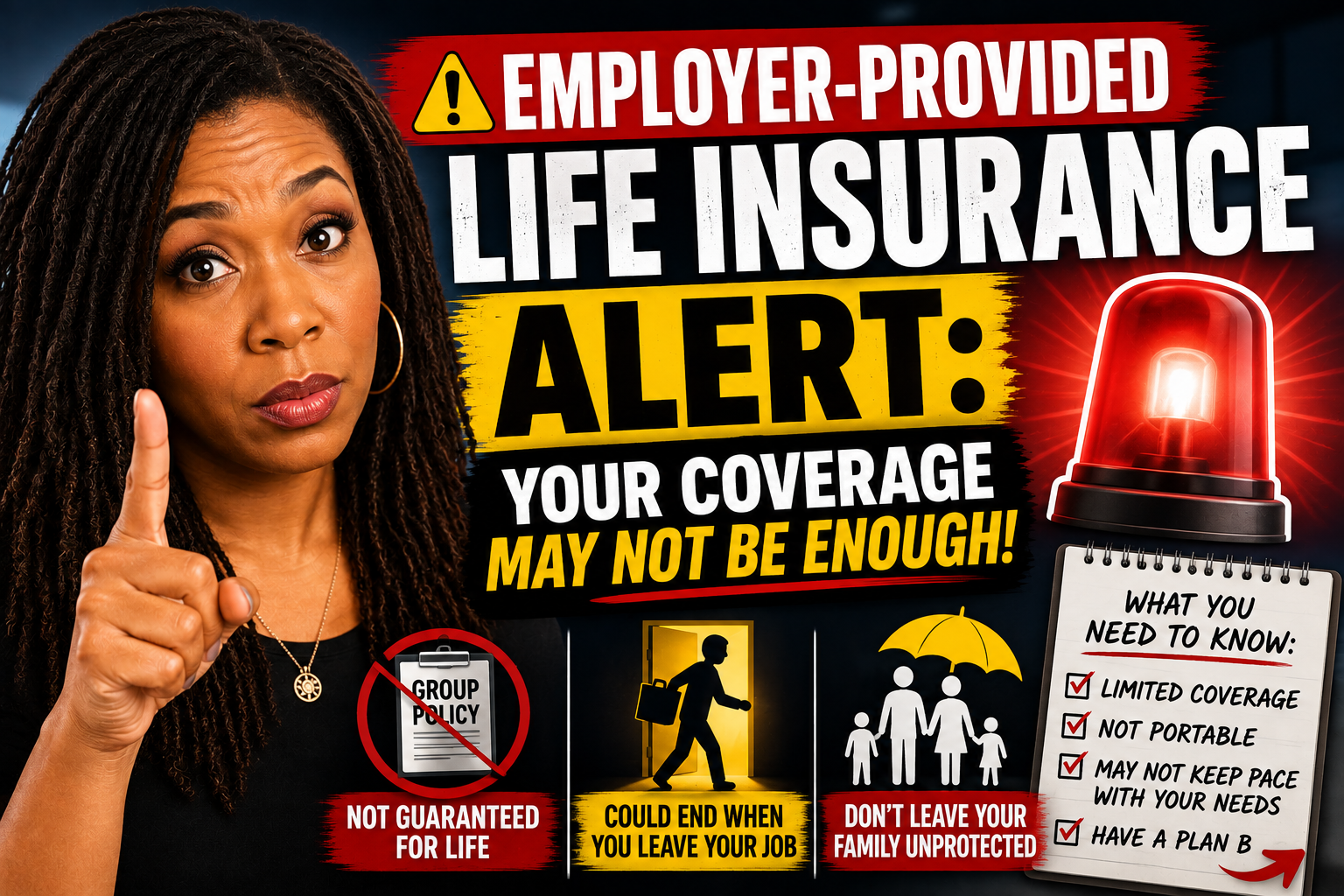
If your employer gives you life insurance through your job, that’s a good benefit to have.
But here’s the question a lot of people never stop to ask:
Is the life insurance through your job actually enough to protect your family?
Because having life insurance and having enough life insurance are two completely different things.
Your employer may provide basic group life insurance as part of your employee benefits package. Some employers may also allow you to purchase additional coverage.
That’s useful.
But before you check “life insurance” off your financial to-do list, you need to understand exactly what you have, how much coverage it provides, and what could happen to that coverage if your employment changes.

Watch: Think Your Job’s Life Insurance Has You Covered?
Before you assume the life insurance from your employer is all your family needs, watch this video.
What Is Employer-Provided Life Insurance?
Employer-provided life insurance is life insurance offered through your job. It is commonly provided through a group insurance arrangement covering eligible employees.
In many cases, the employer provides a basic amount of coverage at little or no direct cost to the employee.
Some employers also give employees the option to purchase additional life insurance through payroll deductions.
The amount of basic coverage varies from employer to employer.
For example, an employer might provide coverage based on:
- A flat dollar amount
- Your annual salary
- A multiple of your salary
- Another formula established by the employer’s benefit plan
That’s why you should never assume you know how much coverage you have simply because your employer says life insurance is included in your benefits.
Your work coverage may be an excellent benefit, but it should be compared against your family’s actual financial needs before you assume you’re fully protected.
How Much Life Insurance Does Your Job Actually Give You?
This should be the first thing you find out.
Don’t settle for:
“Yeah, I got life insurance at work.”
Okay.
How much?
If you don’t know the answer, pull up your employee benefits information or contact your human resources department.
Find the actual death benefit.
Then compare that amount with what your family would potentially need if you died.
Here’s a Simple Example
Suppose you earn $60,000 per year and your employer provides life insurance equal to one year’s salary.
$60,000
Now ask what that $60,000 might need to accomplish.
Would your family need it for:
- Final expenses?
- The mortgage?
- Replacing your income?
- Credit cards or other obligations?
- Childcare?
- College?
- Everyday household expenses?
Suddenly, $60,000 may not look as large as it did on the benefits page.
This example is for illustration only. Actual life insurance needs vary significantly based on income, debts, assets, dependents, goals and other circumstances.

Would One Year’s Salary Be Enough?
For some households, employer coverage may provide meaningful protection.
But a family that depends heavily on your income may need money for much longer than one year.
Imagine your children are 5 and 8 years old.
If something happens to you today, your surviving spouse isn’t just losing your paycheck until next Christmas.
Your family could lose years of:
- Income
- Retirement contributions
- Employer benefits
- Savings contributions
- Financial support for the children
That’s why the amount of insurance you need shouldn’t automatically be based on whatever amount your employer happens to provide.
If you’re a parent, read our guide: How Much Life Insurance Coverage Does a Parent Need?
What Happens to Your Life Insurance If You Leave Your Job?
This is where you really need to understand your specific benefits.
Employer-sponsored coverage is connected to an employer benefit plan, so don’t automatically assume the same coverage will simply follow you wherever you go.
Depending on the plan, coverage could change or end after employment ends. Some plans may offer conversion or portability options that allow eligible employees to continue or replace certain coverage under specified conditions.
But the rules, deadlines and costs can vary.
Ask your employer or benefits administrator exactly what happens to your life insurance if you resign, retire, are laid off, are terminated, or otherwise become ineligible for the group plan.
Why Depending Only on Your Job Can Create a Problem
Here’s something people don’t always think about.
Your need for life insurance doesn’t necessarily disappear because your employment changes.
You could leave your employer while still having:
- A spouse depending on your income
- Children living at home
- A mortgage
- Car payments
- Other debts
- College goals
- Other people depending on you financially
So if your coverage changes when your employment changes, your family’s financial need may still be sitting there waiting on you.

Employer Life Insurance vs. an Individual Life Insurance Policy
An individual life insurance policy is different because you generally apply for and own the coverage independently of your employer.
That distinction can matter.
| Feature | Employer Coverage | Individual Coverage |
|---|---|---|
| Where You Get It | Through your employer | Purchased independently |
| Coverage Amount | Determined by plan options | Based on the policy applied for and approved |
| Job Change | Coverage may be affected; check the plan | Generally not tied to your employer |
| Underwriting | Depends on group plan and coverage level | Depends on insurer and policy |
| Premium | May be employer-paid, employee-paid or shared | Generally paid by the policy owner |
This doesn’t mean employer coverage is bad.
Far from it.
It means you should understand the difference between using your employer coverage as your entire protection plan and using it as one part of a broader life insurance strategy.
Can You Have Employer Life Insurance AND Your Own Policy?
Yes. These don’t have to be an either-or decision.
Someone may have employer-provided coverage and also own an individual life insurance policy, subject to normal underwriting and insurer requirements.
For some families, employer coverage can serve as an additional layer of protection rather than the entire plan.
The important question is whether the total coverage makes sense for your financial needs.
How Do You Know If Your Work Coverage Is Enough?
Start by asking what would happen financially if you died tomorrow.
Consider Your Family’s Needs
- How much income would disappear?
- How many years would your family need support?
- How much is left on the mortgage?
- What other debts or obligations do you have?
- Would your family need childcare?
- Do you want to provide money for education?
- What might final expenses look like?
- Are there other people who depend on you financially?
Then Look at Existing Resources
- Employer-provided life insurance
- Existing individual life insurance
- Appropriate savings and investments
- Other assets or reliable resources
The point isn’t to pick the biggest number possible.
It’s to identify the financial problem your death could create and determine what resources would be available to address it.
What If You Leave Your Job and Don’t Have Other Life Insurance?
If you no longer have applicable employer coverage and don’t have another policy, you could potentially have no life insurance protection at all.
If people still depend on you financially, that’s something you should address.
We’ve covered the potential consequences in: What Happens If You Die Without Life Insurance?
Why Waiting Until You Leave Your Job May Not Be the Best Strategy
Another issue to consider is insurability.
When you apply for an individual life insurance policy, the insurer may consider factors such as your age, health, medical history, tobacco use and other underwriting information.
Waiting several years can mean you’re older when you eventually apply.
Your health could also change.
That doesn’t mean everyone should immediately purchase an individual policy.
It means you shouldn’t assume you’ll always be able to buy the exact same coverage later at the same price or on the same terms.

10 Questions to Ask About Your Employer Life Insurance Today
You don’t have to guess what your benefits provide.
Pull out your benefits information or contact HR and ask:
- How much life insurance do I currently have?
- Who pays the premium?
- Who is listed as my beneficiary?
- Can I purchase additional coverage?
- Does additional coverage require evidence of insurability?
- What happens if I leave the company?
- Can I convert any coverage to an individual policy?
- Is any coverage portable?
- Are there deadlines for exercising those options?
- Where can I get a copy of the plan information?
Don’t Forget to Check Your Beneficiary
Even if your coverage amount is appropriate, there’s another detail you don’t want to ignore:
Who is actually listed as your beneficiary?
If you enrolled in your benefits years ago, your beneficiary information may no longer reflect your wishes.
Major life events are good reasons to review your beneficiary designations, including:
- Marriage
- Divorce
- Birth or adoption of a child
- Death of a beneficiary
- Other significant family changes
Don’t assume it automatically updated itself.
Check it.
Is Employer-Provided Life Insurance Taxable?
There is also a federal tax rule worth knowing.
Under current federal rules, the cost of up to $50,000 of qualifying employer-provided group-term life insurance coverage is generally excluded from an employee’s income.
When employer-carried group-term coverage exceeds $50,000, the calculated cost of coverage above that threshold can generally be included in taxable wages under federal tax rules.
This doesn’t mean you’re taxed on a $50,000 death benefit. The rule concerns the calculated cost of certain employer-provided group-term coverage.
For current federal information, see the IRS information on group-term life insurance .
What Type of Individual Life Insurance Should You Consider?
If this article has you thinking about getting coverage outside of your job, the next step is understanding the different types of life insurance.
Start here: Understanding the Types of Life Insurance in Plain English .
That guide explains the major types in everyday language so you can better understand what you’re comparing.
Continue Learning About Life Insurance
Frequently Asked Questions
Is life insurance through my employer enough?
It depends on how much coverage your employer provides and how much your family would actually need if you died. Compare the death benefit with your income-replacement needs, mortgage, debts, childcare, education goals, final expenses and other financial responsibilities.
What happens to my employer life insurance when I quit?
It depends on your employer’s plan. Coverage may end or change when employment ends, while some plans may provide portability or conversion options. Review your specific plan documents and ask your benefits administrator about requirements and deadlines.
Can I have my own life insurance and employer life insurance?
Yes. Having group coverage through an employer doesn’t generally prevent you from applying for an individual life insurance policy, subject to the individual insurer’s underwriting requirements.
Is employer-provided life insurance free?
Sometimes employers pay for basic coverage, while other plans may require employees to pay some or all of the cost. Optional supplemental coverage may also be available for an additional premium. Check your benefits information for the details.
Can I keep employer life insurance after I retire?
Possibly, depending on the plan. Do not assume your active-employee coverage will continue unchanged. Ask your benefits administrator what happens at retirement and whether continuation, conversion or portability options apply.
How much life insurance should I have?
There is no single amount that’s appropriate for everyone. Consider your income, debts, mortgage or rent, dependents, childcare, education goals, existing assets and other financial responsibilities.
Should I cancel my employer life insurance if I buy my own policy?
Not automatically. Employer coverage can still provide valuable additional protection. Compare the cost, benefits, limitations and your total insurance needs before changing any existing coverage.
The Bottom Line
Employer-provided life insurance can be a valuable employee benefit.
Take advantage of good benefits when they make sense for you.
But don’t confuse:
“I have life insurance through my job.”
with
“My family has enough life insurance protection.”
Those are not necessarily the same thing.
Find out exactly how much coverage you have.
Find out what happens to it if your employment changes.
Review your beneficiaries.
Then compare your coverage with the financial needs of the people who depend on you.
If there’s a gap, you can decide whether additional coverage makes sense for your situation.
Not Sure If Your Work Life Insurance Is Enough?
Your employer coverage can be a great start. Now find out whether additional life insurance options may make sense for you and your family.
EXPLORE MY LIFE INSURANCE OPTIONSCoverage availability, eligibility and rates depend on individual circumstances and insurer requirements.
And remember: life happens.
Be prepared, stay protected, and always put your family first.