


If you have people in your life who rely on you financially—a spouse, children, aging parents, or even a business partner—life insurance is one of the most important financial safety nets you can put in place.
Despite its importance, the world of insurance can sometimes feel overwhelming, filled with complicated jargon and endless options. Let’s break it down into plain English so you can understand exactly how life insurance works and how it protects the people you care about most.
What Is Life Insurance?

At its core, life insurance is a contract between you and an insurance company.
Here is how the basic agreement works:
- Your Part: You agree to make regular payments (called premiums).
- The Company’s Part: In exchange for your payments, the insurer guarantees that when you pass away, they will pay a tax-free lump sum of money (called a death benefit) to the specific people or organizations you choose (your beneficiaries).
Think of it as a financial umbrella: you hope for sunny days, but if a storm comes, your loved ones aren’t left stranded in the rain.
Key Terms You Need to Know
To understand how a policy works, it helps to know a few standard terms:
| Term | What It Means |
| Policyholder | The owner of the insurance contract (usually you). |
| Insured | The person whose life is covered by the policy. |
| Beneficiary | The person or entity (like a trust) designated to receive the payout. |
| Premium | The fee paid monthly or annually to keep the policy active. |
| Death Benefit | The tax-free payout received by the beneficiary when the insured passes away. |
| Cash Value | A tax-deferred savings component built into certain permanent policies. |
How Does Life Insurance Work? Step-by-Step
Understanding the life cycle of a policy helps take the mystery out of the process:
1. You Apply and Select Your Coverage
You choose how much coverage you need (e.g., $250,000, $500,000, or $1,000,000) based on your family’s needs, debts, and income.
2. Underwriting Takes Place
The insurance company evaluates your health, age, lifestyle, and medical history to calculate your risk. This determines how much your premium will cost. Some policies require a quick medical exam, while others offer instant-decision, simplified underwriting online.
3. You Pay Your Premiums
You pay your premiums on a regular schedule (monthly or annually). As long as you pay on time, your policy remains active and in force.
4. The Payout (Claim Process)
If the insured person passes away while the policy is active, the beneficiary files a claim by submitting a death certificate to the insurer. The insurance company then processes the payout—typically as a tax-free, lump-sum check.
The Two Main Types of Life Insurance
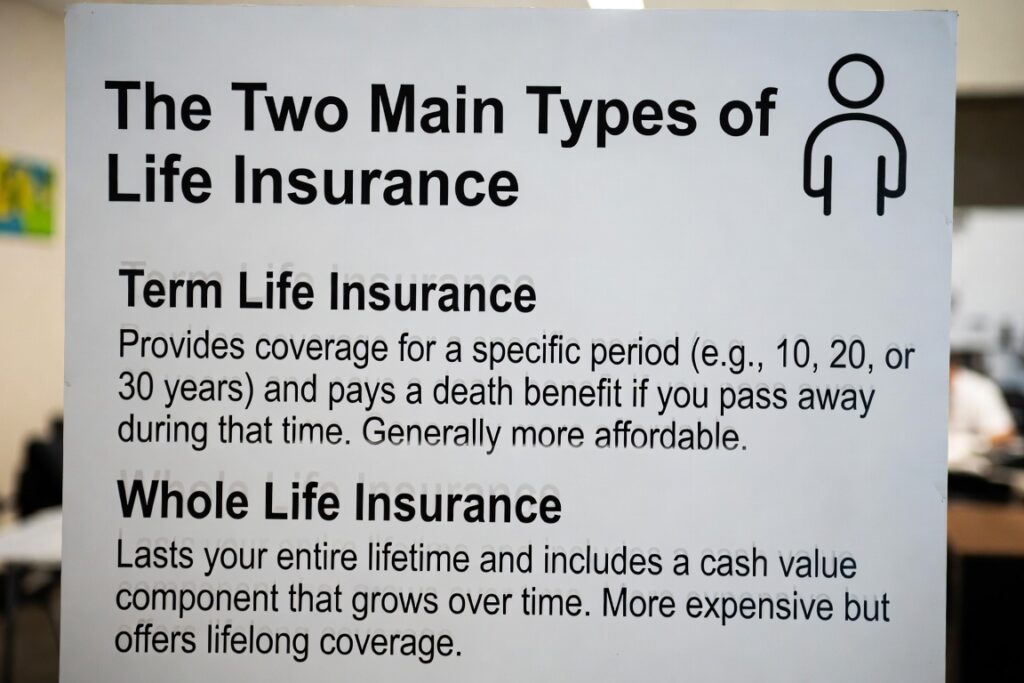
While there are many variations, almost all policies fall into two main categories: Term and Permanent.
1. Term Life Insurance (Temporary & Affordable)
Term life insurance is the simplest and most cost-effective type of coverage.
- How it works: It covers you for a set period—usually 10, 15, 20, or 30 years.
- The catch: If you outlive the term, the policy ends, and there is no payout.
- Best for: Replacing lost income while raising kids, covering a 30-year mortgage, or securing affordable coverage during your peak earning years.
2. Permanent Life Insurance (Lifelong & Cash-Building)
Permanent insurance provides lifelong coverage as long as premiums are paid.
- How it works: It never expires and includes a cash value account that grows tax-deferred over time. You can borrow against or withdraw from this cash value while you are alive.
- Common types: Whole Life (fixed premiums and guaranteed cash value growth) and Universal Life / Indexed Universal Life (IUL) (flexible premiums and growth tied to market indices).
- Best for: Final expenses, estate planning, leaving a legacy, or building tax-advantaged wealth.
What Can the Death Benefit Be Used For?
Once your beneficiaries receive the death benefit, there are no legal restrictions on how they spend it. Common uses include:
- Replacing lost income to maintain everyday living standards.
- Paying off a mortgage so the family can stay in their home.
- Covering funeral and burial costs (which easily average $7,000–$10,000+).
- Paying off debts like credit cards, personal loans, or medical bills.
- Funding college education for surviving children or grandchildren.
When Is the Best Time to Get Life Insurance?

The short answer? Now.
Life insurance premiums are calculated primarily based on your age and health. The younger and healthier you are when you apply, the lower your rates will be. Locking in a policy today guarantees that your rate stays low, protecting your family regardless of what health changes may happen down the road.
Bottom Line: Life insurance isn’t really about money for you—it’s about peace of mind for the people you leave behind. It ensures that your hard work, love, and protection live on no matter what tomorrow brings. Get Insurance today.


Leave a Reply