Being self-employed sounds wonderful until you realize something: you’re not just the boss. You’re also the human resources department, the payroll department, and the person responsible for finding your own health insurance!
And if you’ve ever shopped for health insurance on your own, you already know how confusing it can get.
You’ve got premiums, deductibles, copays, networks, and all kinds of insurance terms flying at you.
But here’s the good news: you don’t have to work for a big company to get comprehensive health insurance.
Whether you’re a freelancer, independent contractor, gig worker, consultant, or small business owner, you may have several options for getting coverage.
Let’s talk about how to find health insurance when you work for yourself—and how to choose a plan without wrecking your budget.
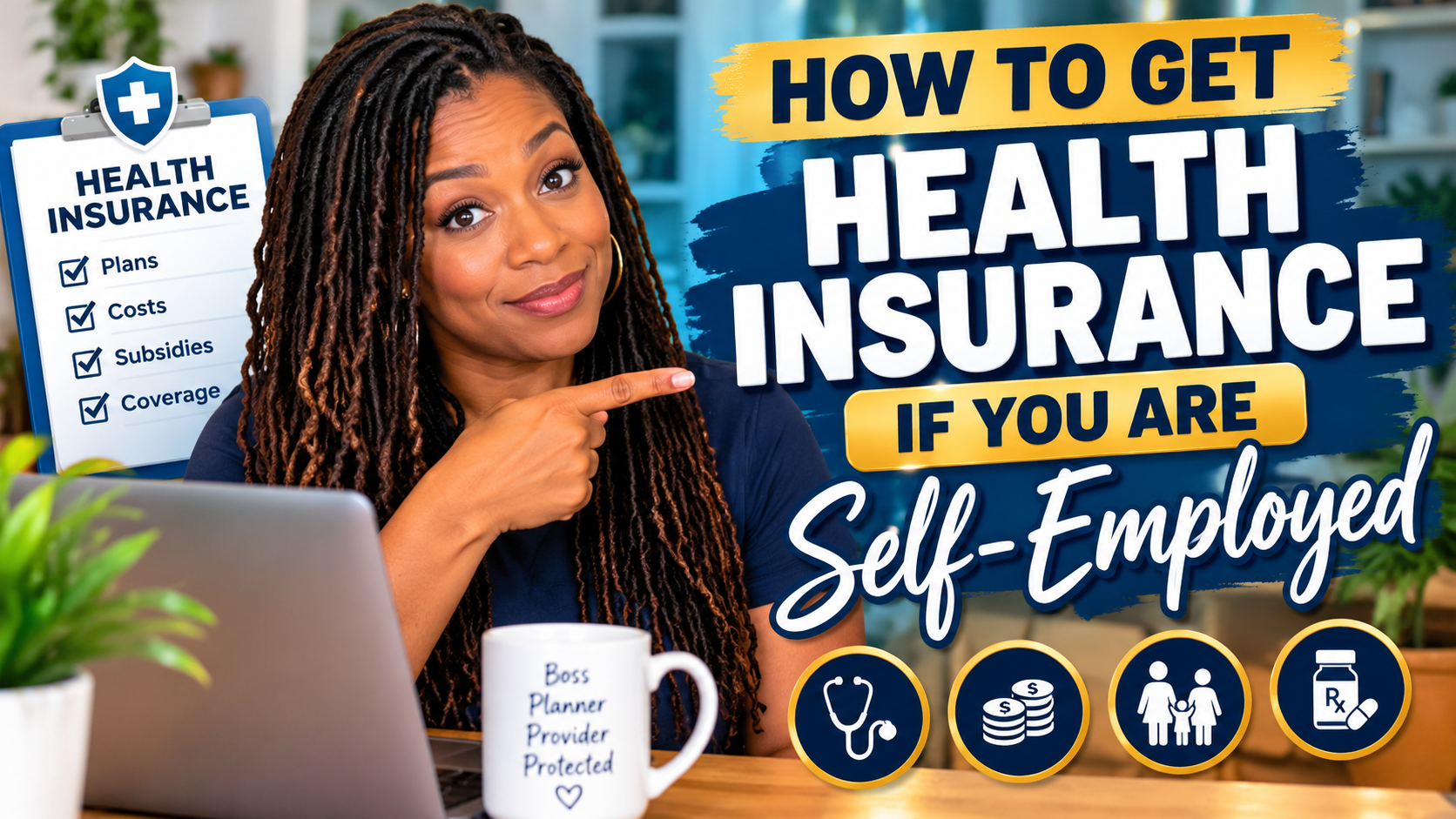
Watch: How to Get Health Insurance If You’re Self-Employed

The key is knowing where to look, understanding what you’re paying for, and comparing your options before enrolling.
1. Start With the Health Insurance Marketplace
For many self-employed people, one of the first places worth exploring is the Health Insurance Marketplace.
The Marketplace offers individual and family health insurance plans that meet Affordable Care Act requirements.
These plans generally include essential health benefits such as:
- Doctor visits and outpatient care
- Emergency services
- Hospitalization
- Prescription drug coverage
- Maternity and newborn care
- Mental health and substance use disorder services
- Preventive services
ACA-compliant Marketplace plans cannot deny you coverage or charge you more because of a pre-existing medical condition.
And depending on your household income and other eligibility factors, you might qualify for financial assistance that lowers your monthly premium.
Helpful tip: You don’t have to have employees to shop for individual Marketplace coverage. Freelancers, sole proprietors, and independent contractors can apply.
2. Understand How Your Self-Employment Income Affects Your Costs
This is especially important if your income changes from month to month.
When you apply for Marketplace coverage, you’ll need to estimate your household income for the year you’re seeking coverage.
For your self-employment earnings, you’ll generally estimate your net business income—your business revenue minus allowable business expenses.
But remember: Marketplace eligibility considers your household’s applicable income, not just the money from your business.
Example: Calculating Net Business Income
Let’s say your freelance business brings in $50,000 during the year and you have $12,000 in allowable business expenses.
$50,000 − $12,000 = $38,000 estimated net business income.
That $38,000 may be one component of your household income used to determine Marketplace eligibility. Other income and adjustments can also matter.
Because business income can change, it’s important to update your Marketplace application when your annual income estimate changes significantly.
Otherwise, you could receive too much advance premium tax credit and have to repay some or all of it when filing your federal tax return.
Helpful tip: Keep a record of your income and business expenses throughout the year. Accurate bookkeeping can make your Marketplace application easier.
3. Compare the Real Cost of Health Insurance
Here’s where many people make a mistake.
They see a plan with a low monthly payment and immediately assume it’s the best deal.
But the monthly premium is only one part of what health insurance can cost.
Monthly Premium
The amount you pay each month to maintain your health insurance coverage.
Deductible
The amount you may need to pay for certain covered services before the plan begins sharing costs.
Copays and Coinsurance
Your share of the cost when receiving covered medical services.
Out-of-Pocket Maximum
The annual limit on covered in-network cost-sharing. Premiums and some other expenses are excluded.
Let’s look at two imaginary plans.
| Plan Feature | Plan A | Plan B |
|---|---|---|
| Monthly premium | $180 | $320 |
| Annual premiums | $2,160 | $3,840 |
| Deductible | $6,500 | $2,000 |
| Out-of-pocket maximum | $9,000 | $5,000 |
| Annual premiums plus maximum covered in-network cost-sharing | $11,160 | $8,840 |
These are hypothetical examples, not actual quotes. The final row illustrates a high-expense year, not what everyone will spend. Noncovered services and certain other expenses can cost extra.
Plan A has the lower monthly premium. But Plan B could cost less overall during a year when you need extensive medical care.
Neither plan is automatically better. Your healthcare needs, prescriptions, savings, and budget all matter.
Money-saving tip: Compare the total expected yearly cost of coverage, not just the advertised monthly premium.
4. Check Whether You Qualify for Financial Assistance
Just because you’re self-employed doesn’t mean you have to pay the full advertised cost of health insurance.
Depending on your eligibility, you may qualify for a premium tax credit through the Marketplace.
This assistance can reduce the monthly premium you pay for qualifying coverage.
Some households may also qualify for cost-sharing reductions that lower certain deductibles, copays, and other out-of-pocket expenses when they enroll in an eligible Silver plan.
Eligibility depends on current rules, household income, family size, and other factors.
Children may also qualify for CHIP even when their parents use a different coverage option.
To explore your eligibility, visit HealthCare.gov.
Helpful tip: Always check your actual eligibility for the coverage year. Tax credits and plan prices can change, so don’t rely on an estimate from a previous year.
5. Be Careful When Comparing Private Health Insurance
You may also see health insurance options advertised outside the Marketplace.
Some are comprehensive ACA-compliant plans. Others are short-term, fixed-indemnity, or limited-benefit products.
And those products are not interchangeable.
For example, a limited-benefit plan might pay a specified amount for certain services rather than covering your medical expenses in the same way as comprehensive major medical insurance.
Some non-ACA plans may exclude pre-existing conditions, limit benefits, or omit important categories of care.
Questions to Ask Before Buying a Private Plan
- Is this comprehensive major medical coverage?
- Does the plan comply with ACA individual-market requirements?
- Are pre-existing conditions covered?
- Does it cover hospitalization and prescription medications?
- What are the deductibles, exclusions, and benefit limits?
- Can I use my preferred doctors and hospitals?
A lower price isn’t necessarily a bargain if the coverage doesn’t meet your medical needs.
6. Don’t Forget About Other Coverage Options
The Marketplace isn’t the only possible option.
Depending on your situation, you may also want to investigate:
- A spouse’s employer-sponsored plan: If available, check whether you can enroll and what it would cost.
- Medicaid: Eligibility depends on your state and personal circumstances.
- CHIP: Children in eligible households may qualify for low-cost coverage.
- COBRA: If you’ve recently left a job, you may be able to temporarily continue your former employer’s group coverage, usually at a higher cost.
- Small-group coverage: If your business has eligible employees, different small-business insurance options may apply.
Compare each option based on eligibility, benefits, provider networks, and total cost.
7. Know When You Can Sign Up
For HealthCare.gov, Open Enrollment for 2027 coverage begins November 1, 2026 and generally runs through January 15, 2027.
State-based Marketplaces may have different deadlines.
Outside Open Enrollment, you generally need to qualify for a Special Enrollment Period to enroll in Marketplace coverage.
Qualifying life events may include:
- Losing eligible health coverage
- Getting married
- Having a baby or adopting a child
- Moving to a new area under qualifying circumstances
- Other eligible changes in your situation
Medicaid and CHIP applications can generally be submitted year-round.
Important: Simply being self-employed does not automatically qualify you for a Special Enrollment Period. Check your eligibility and the applicable enrollment dates.
8. Can Self-Employed People Deduct Health Insurance Premiums?
Possibly.
Eligible self-employed individuals may be able to claim a federal income tax deduction for qualifying health insurance premiums.
There are important rules involving business income, eligibility for employer-sponsored coverage, and the treatment of Marketplace premium tax credits.
The deduction is not the same as receiving a dollar-for-dollar tax credit, and it generally doesn’t reduce self-employment tax.
Check the IRS guidance on the self-employed health insurance deduction or consult a qualified tax professional before claiming it.
How to Choose Your Plan: A Simple Checklist
- Estimate your income. Use a realistic projection of your household income for the coverage year.
- Set your budget. Decide what you can afford monthly and during an unexpected medical expense.
- Check financial assistance. Find out whether you qualify for Marketplace savings, Medicaid, or CHIP.
- Compare plans. Review premiums, deductibles, copays, and out-of-pocket maximums.
- Check your doctors. Verify that your preferred providers are in-network.
- Check your medications. Review prescription coverage and pharmacy networks.
- Read the details. Look for exclusions, limits, and enrollment requirements.
- Confirm your coverage. Complete enrollment, pay any required initial premium, and verify your start date.
Frequently Asked Questions
Can I get health insurance if I’m self-employed with no employees?
Yes. Eligible freelancers, contractors, and sole proprietors can shop for individual health insurance through the Marketplace or other available sources.
What if my self-employment income changes every month?
Use your best estimate of annual household income when applying. Update your Marketplace application when your expected yearly income changes.
Can I qualify for health insurance subsidies if I own a business?
Possibly. Owning a business doesn’t automatically disqualify you. Eligibility depends on household income, access to other qualifying coverage, and current program rules.
Can I get health insurance if I have a pre-existing condition?
Yes. ACA-compliant individual Marketplace plans cannot deny coverage or charge more because of a pre-existing condition.
Do I need an LLC to get self-employed health insurance?
No. You don’t need an LLC to apply for individual Marketplace coverage. Freelancers and sole proprietors can also apply.
Is the cheapest health insurance plan the best choice?
Not necessarily. A low monthly premium can come with higher deductibles and other out-of-pocket expenses. Compare the total costs and benefits before choosing.
The Bottom Line: Being Your Own Boss Doesn’t Mean Going Without Coverage
When you’re self-employed, you have enough responsibilities already.
You’re running your business, managing your money, finding customers, and keeping everything moving.
Health insurance shouldn’t be another mystery you have to solve.
Start by exploring your coverage options, checking your eligibility for financial assistance, and comparing the actual costs.
Because working for yourself should give you more freedom—not leave you without a plan for protecting your health and finances.
Self-Employed and Looking for Health Insurance?
At Just 4 My Family, we help individuals, freelancers, and business owners explore health insurance options that fit their needs and budgets.
Whether you’re newly self-employed or have been running your business for years, you can take the next step toward understanding your coverage choices.
Explore Health Insurance OptionsAnd remember: life happens. Be prepared, stay protected, and always put your family first.
Disclaimer: This article provides general educational information, not individualized insurance, legal, or tax advice. Coverage, costs, eligibility, and enrollment rules vary by plan, state, and year. Always review current official guidance and actual plan documents before making insurance decisions.