
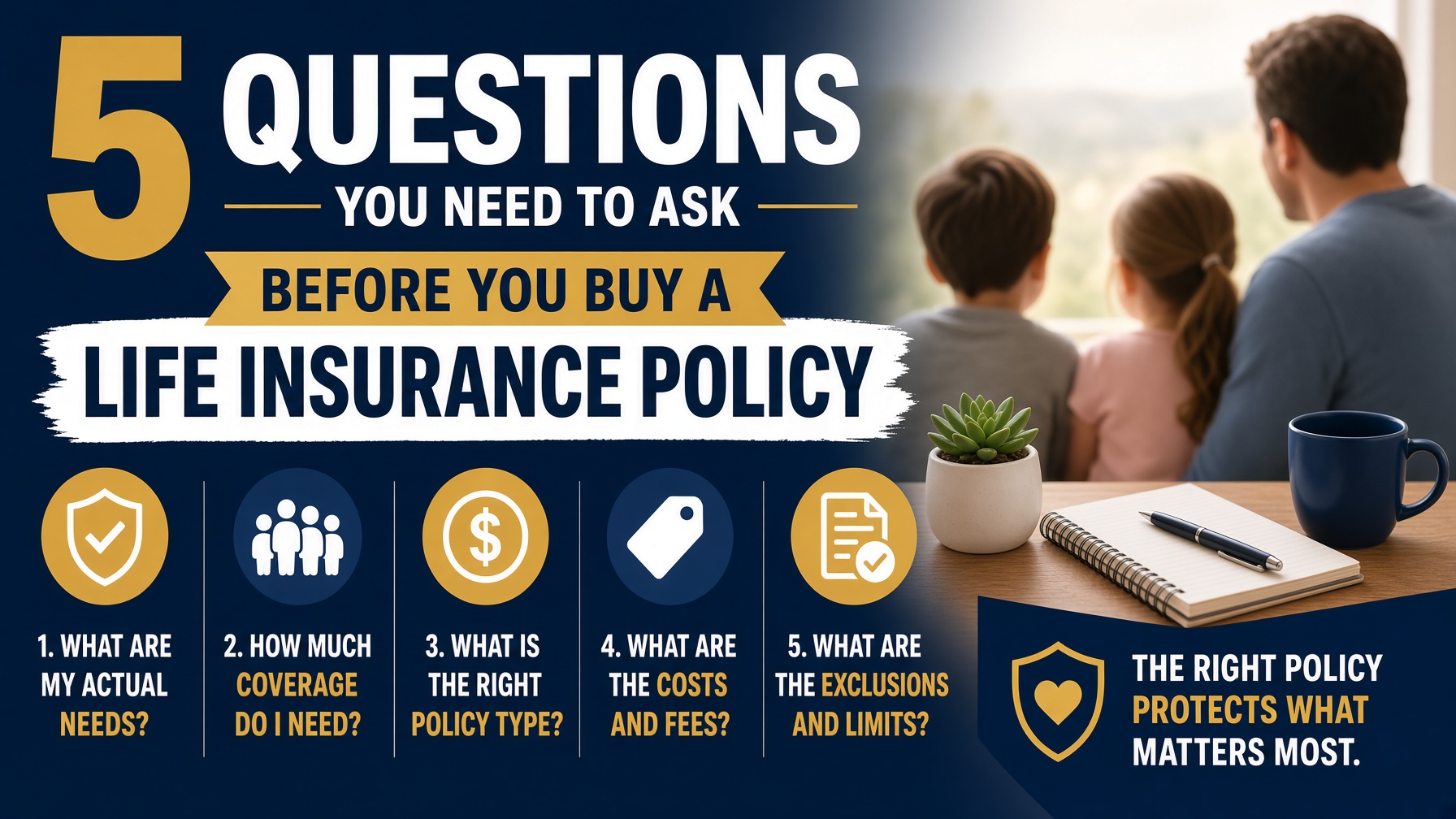
Buying life insurance is one of those decisions that can make a big difference for your family’s financial future.
But here’s the thing: not every life insurance policy works the same way.
Some policies provide coverage for a specific number of years. Others are designed to last longer. Some build cash value, while others focus on providing a death benefit at a lower initial cost.
And if you don’t know what questions to ask before you buy, you could end up with a policy that doesn’t match your family’s needs or your budget.
Before you sign an application or make that first payment, here are five important questions worth asking.
Watch: 5 Questions You Need to Ask Before You Buy a Life Insurance Policy

The right questions can help you compare coverage, understand costs, and avoid unpleasant surprises later.
1 How Much Life Insurance Do I Actually Need?
Before choosing a policy, figure out what you want the coverage to accomplish.
Are you trying to help your family pay the mortgage? Replace your income? Cover final expenses? Provide for your children’s education?
Maybe it’s a combination of all four.
Let’s say your family depends on $40,000 a year of your income. If they needed five years of that support, that’s $200,000 before considering other expenses or available resources.
Now, that doesn’t mean everybody needs exactly five years of income replacement.
It means your coverage should be based on your family’s actual financial needs rather than an arbitrary number.
Consider These Financial Needs
- Income your family would need to replace
- Housing and everyday living expenses
- Childcare and education costs
- Final expenses
- Financial support for other dependents
Then subtract available savings, existing insurance, and other resources your family could reasonably use.
Ask your agent: “Based on my income, dependents, debts, and existing savings, how much coverage should I consider—and why?”
2 Should I Buy Term Life or Permanent Life Insurance?
This is where a lot of people get confused.
Two major categories of life insurance are term life insurance and permanent life insurance.
Term Life Insurance
Term life insurance provides coverage for a specified period, such as 10, 20, or 30 years, depending on the product.
If the insured person dies while the policy is active during that term, the policy generally pays the covered death benefit, subject to its terms.
Term coverage often has lower initial premiums than permanent life insurance for comparable death benefits.
Permanent Life Insurance
Permanent life insurance is designed to provide longer-term coverage and generally includes a cash-value feature.
Examples include whole life and universal life insurance.
However, permanent policies can have different premium structures, guarantees, charges, and risks. Coverage may lapse if the policy isn’t adequately funded.
| Term Life Insurance | Permanent Life Insurance |
|---|---|
| Coverage for a defined term | Designed for longer-term coverage |
| Often lower initial premiums | Often higher initial premiums |
| Usually no cash value | Generally includes cash value |
| May offer renewal or conversion options | Features vary by policy type |
Neither category is automatically best for everyone.
Ask your agent: “Why are you recommending this type of policy for my situation, and what would I gain or give up by choosing the alternative?”
3 Will My Premium Stay the Same?
Now, this is a question you definitely want answered before buying.
Imagine purchasing a policy because the payment fits your budget, only to discover later that the cost could increase.
Some term policies have level premiums during a guaranteed period, but premiums may rise significantly if you renew afterward.
Some permanent policies have guaranteed premiums. Others allow flexible payments but require enough funding to cover ongoing policy charges.
And with certain permanent policies, changes in interest rates, investment performance, or insurance charges may affect the amount needed to keep coverage active.
Don’t assume a quoted premium is guaranteed forever.
Ask your agent: “Is this premium guaranteed? If so, for how long? What is the highest amount I might need to pay to keep the policy active?”
4 What Could Prevent My Family From Receiving the Full Benefit?
When you’re buying life insurance, it’s important to understand not just what is covered, but also the circumstances that could affect a claim.
Depending on the policy, there may be exclusions, contestability provisions, waiting periods, or graded death benefits.
For example, some guaranteed-issue policies limit the benefit payable for certain deaths during an initial period.
And if material information is misrepresented on an application, that could create problems with coverage or a future claim under applicable law.
That’s why you should answer application questions honestly and carefully review the policy terms.
Also ask when coverage actually begins. Submitting an application or making a payment doesn’t always mean full coverage is immediately in force.
Ask your agent: “When does my coverage begin, what exclusions or waiting periods apply, and under what circumstances could a death benefit be reduced or denied?”
5 Who Will Receive the Money, and Can I Change My Beneficiaries?
Life insurance is meant to help protect the people who matter most to you.
But you need to make sure the right people are named on your policy.
A beneficiary is the person or organization designated to receive the policy’s death benefit.
You may be able to name primary beneficiaries and contingent beneficiaries, depending on your policy.
A contingent beneficiary generally receives the benefit if the primary beneficiary cannot receive it under the policy’s terms.
Beneficiary arrangements can become more complicated when children are minors, a trust is involved, or a beneficiary designation is irrevocable.
Review your beneficiary choices carefully and update them when appropriate after major life events.

Ask your agent: “Who should I name as my primary and contingent beneficiaries, and what steps would I need to take to change them later?”
Bonus: Three Things to Check Before Signing
Along with those five questions, take a few extra minutes to review these details:
- The insurance company: Confirm that the insurer is licensed in your state and review its financial strength.
- Your application: Make sure your health, lifestyle, and other answers are accurate and complete.
- Your policy documents: Review the actual policy, including guarantees, exclusions, riders, and any applicable free-look period.
The National Association of Insurance Commissioners provides additional consumer guidance for comparing life insurance policies.
Frequently Asked Questions
Is term life insurance better than whole life?
It depends on your needs. Term coverage may be appropriate for a defined period of financial responsibility, while permanent coverage may suit certain long-term goals. Compare the actual costs and policy features.
Can I buy life insurance if I have a medical condition?
Possibly. Eligibility and pricing depend on your health history, the insurer’s underwriting guidelines, and the type of policy. Different insurers may evaluate the same condition differently.
Can I own more than one life insurance policy?
Yes. Multiple policies are generally possible, subject to underwriting, financial justification, and insurer limits.
Can I change my life insurance beneficiaries later?
Often, yes. However, irrevocable beneficiary arrangements, ownership rules, and certain legal circumstances can limit changes. Check your policy.
Should I cancel my old policy when buying a new one?
Not automatically. Compare both policies carefully and keep existing coverage in force until any intended replacement is approved and active.
The Bottom Line: Ask Questions Before You Buy
Life insurance shouldn’t be something you buy simply because somebody told you it was a good idea.
You should understand what you’re paying for, how long the coverage lasts, what could affect the benefit, and whether the premiums fit your budget.
Because the goal isn’t just to own a life insurance policy.
The goal is to have coverage that makes sense for your family’s financial needs.
Ready to Explore Life Insurance Options?
At Just 4 My Family, we help individuals and families explore life insurance options with their needs and budgets in mind.
Before you make a decision, take the time to understand your coverage choices.
Explore Life Insurance OptionsAnd remember: life happens. Be prepared, stay protected, and always put your family first.
Disclaimer: This article is for general educational purposes and does not provide individualized insurance, financial, tax, or legal advice. Coverage, premiums, exclusions, eligibility, and benefits vary by insurer, policy, applicant, and state. Always review the actual policy documents before purchasing or changing coverage.