
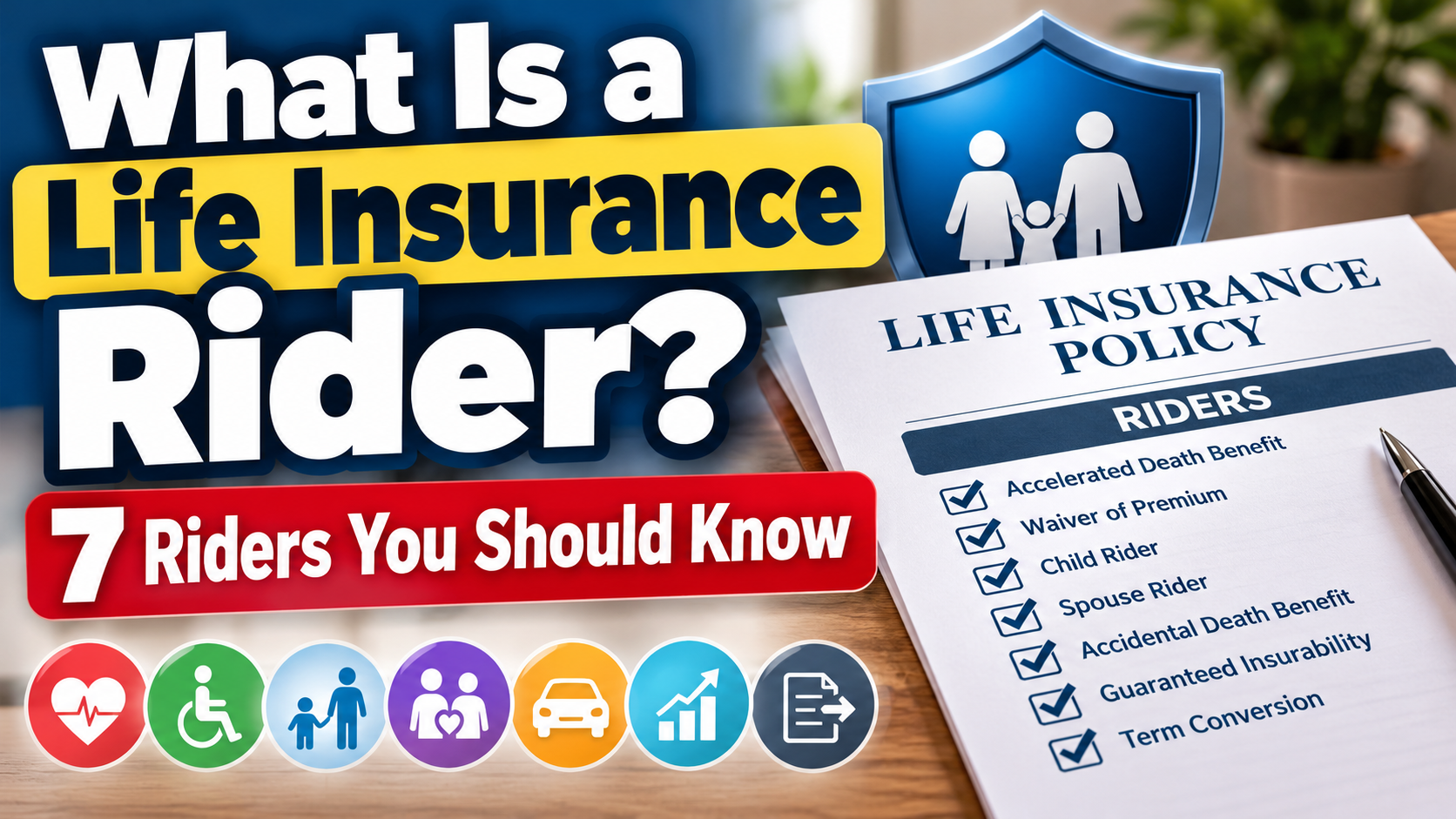
What Is a Life Insurance Rider? 7 Riders You Should Know
When you buy life insurance, the basic policy isn’t always the whole story. You may also be offered something called a life insurance rider.
But what exactly is a rider? Do you need one? And are you paying extra for something you may never use?
Let’s break it down in plain English so you can understand what you’re buying before you sign anything.
Think of a Rider as an Add-On
Your main life insurance policy provides the foundation. A rider changes or adds certain benefits or features to that policy.
What Is a Life Insurance Rider?
A life insurance rider is an additional provision that modifies the benefits or terms of your life insurance policy.
Think about buying a car. The base model gets you from point A to point B, but you might choose additional features depending on what you need.
Life insurance riders work in a similar way.
Some riders provide additional protection. Others may allow you to access certain benefits while you’re still alive or provide coverage for specific circumstances.
Some riders cost extra, while others may be included with certain policies. Availability, qualifications, costs, limitations and definitions vary by insurance company and policy.
If you’re still trying to understand the basic types of coverage first, read my guide on the different types of life insurance in plain English .
Why Would You Add a Rider?
A rider can help customize a policy around your needs rather than relying only on the standard death benefit.
Depending on the policy, riders may help with situations involving:
- Terminal or qualifying illnesses
- Disability
- Accidental death
- Future changes in your insurance needs
- Coverage for a spouse or child
- Converting certain term coverage to permanent coverage
7 Common Life Insurance Riders
1. Accelerated Death Benefit Rider
An accelerated death benefit rider, sometimes described as a living benefit, may allow you to access part of your policy’s death benefit while you’re still alive if you meet the rider’s qualifying conditions.
For example, some policies may allow access after a qualifying terminal illness diagnosis.
This can provide money when a family is dealing with a serious financial situation, but taking an accelerated benefit generally reduces the amount ultimately available to beneficiaries.
Always read the policy carefully because the qualifying conditions, available amount, charges and effect on the remaining death benefit can differ.
2. Waiver of Premium Rider
A waiver of premium rider may waive required life insurance premiums if you meet the policy’s definition of a qualifying disability or other covered condition.
The exact definition matters.
Don’t assume that every disability automatically qualifies. There may be waiting periods, age limits and specific policy requirements.
3. Child Term Rider
A child term rider may provide a limited amount of life insurance coverage for eligible children under a parent’s policy.
Depending on the contract, coverage may last until a certain age and may provide options for future coverage.
This doesn’t mean every parent automatically needs a child rider. The decision should be based on your family’s circumstances, the cost and what the rider actually provides.
4. Spouse Rider
A spouse rider may allow you to add a certain amount of life insurance coverage for your spouse under your policy.
Before choosing this option, compare it with purchasing a separate policy for your spouse.
A separate policy may provide more flexibility in some situations, while a rider may be appropriate in others.
5. Accidental Death Benefit Rider
An accidental death benefit rider may pay an additional benefit when death results from an accident that meets the policy’s definition.
This is where reading the fine print becomes especially important.
The insurance contract determines what qualifies as an accident and what exclusions apply.
Don’t confuse an accidental death rider with regular life insurance. Your primary life insurance coverage is still the foundation.
6. Guaranteed Insurability Rider
A guaranteed insurability rider may give you opportunities to purchase additional life insurance at certain times or qualifying events without going through new medical underwriting.
That could become valuable if your health changes later.
However, these riders have rules about when additional coverage can be purchased, how much can be added and when the option expires.
7. Term Conversion Rider or Provision
Some term life insurance policies include a conversion privilege that allows eligible term coverage to be converted into a permanent life insurance policy without new medical underwriting.
That can become important if your health changes during your term.
But there are usually deadlines and restrictions.
If you’re comparing term and permanent insurance, read: Term vs. Whole Life: Which Is Right for You?
Do Life Insurance Riders Cost Extra?
They can.
Some riders may be included with a policy, while others require an additional premium. The cost can depend on the rider, policy, insurance company, age, coverage amount and underwriting.
That’s why I don’t recommend choosing a policy based on the number of riders it advertises.
More features don’t automatically mean a better policy.
What matters is whether the coverage solves the problem you’re actually trying to solve.
What About Living Benefits?
You’ve probably heard people online talk about life insurance that lets you “use your money while you’re alive.”
Be careful with that wording.
Certain policies may include accelerated benefit provisions that allow access to part of the death benefit after specific qualifying events. That is very different from simply being able to withdraw your entire death benefit whenever you want.
And if you’re looking at permanent coverage because of cash value or policy loans, that’s another subject entirely.
Read my guide: How to Borrow Against Life Insurance: Policy Loans Explained .
You can also learn how indexed universal life insurance works here: IUL Explained: How Indexed Universal Life Insurance Really Works .
Does Everyone Need Riders?
No.
This is one of the most important things I want you to understand.
Don’t add riders simply because they sound impressive.
Before adding one, ask:
- What exactly does this rider cover?
- What triggers the benefit?
- What doesn’t it cover?
- How much does it cost?
- Does the rider expire at a certain age?
- Will using the rider reduce my death benefit?
- Could I get better protection another way?
These are the kinds of questions you should be asking before purchasing a policy—not after your family needs it.
You may also want to read: Life Insurance Red Flags: 7 Warning Signs Before You Buy .
Riders for Seniors
If you’re shopping for coverage after age 65, don’t assume every rider or policy feature will still be available.
Age limits, underwriting requirements, coverage amounts and policy options can vary significantly.
If you’re 65 or older, start here: If You Are 65 and Older With No Life Insurance, Read This .
And if your primary concern is funeral and burial costs, read: What Is Final Expense Insurance? .
The Bottom Line
Life insurance riders can make a policy more flexible, but they’re not something you should add without understanding them.
The right question isn’t:
“How many riders can I get?”
The better question is:
“What protection does my family actually need?”
Once you know that, you can compare the policy, the riders and the cost together.
Not Sure Which Life Insurance Policy Fits Your Family?
You don’t have to figure it out by yourself. I can help you look at your needs, understand your options and determine what type of coverage may make sense for your situation.
Request a Life Insurance QuoteNo pressure. Just straightforward help understanding your options.
Before You Buy
Life insurance products, riders, availability, eligibility, costs and policy provisions vary by insurance company and state. Always review the actual insurance contract and rider before purchasing coverage.
For additional consumer information about life insurance and riders, visit the National Association of Insurance Commissioners (NAIC) .
And remember: life happens. Be prepared, stay protected, and always put your family first.