

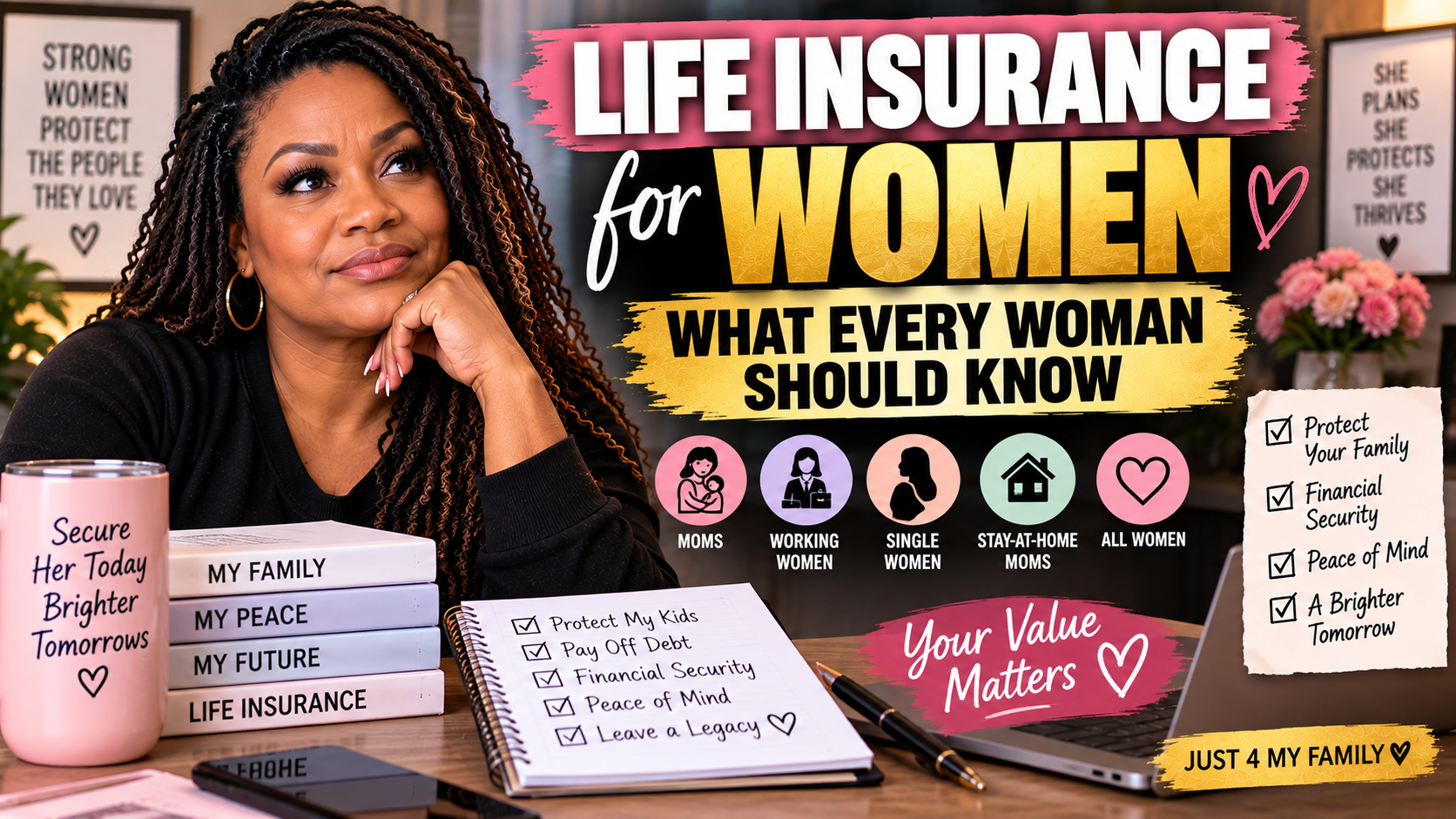
Life Insurance for Women: What Every Woman Should Know
Women spend a lot of time protecting everybody else. We take care of children, spouses, parents, homes, careers and businesses. But there’s one financial question many women don’t stop to ask:
What would happen financially to the people I love if I wasn’t here tomorrow?
That’s where life insurance becomes important.
And one of the biggest mistakes families can make is assuming a woman’s life insurance needs should be based only on her paycheck.
Whether you’re a working woman, stay-at-home mom, single woman, wife, business owner, caregiver or somewhere in between, your financial value can extend far beyond the income deposited into your bank account.
Watch: Life Insurance for Women – What Every Woman Should Know
Why Do Women Need Life Insurance?
Life insurance is designed to provide a death benefit to the beneficiaries named in the policy when the insured person dies, subject to the terms of the policy.
That money can help the people left behind handle financial obligations that don’t disappear simply because someone dies.
For a woman with people who depend on her, those needs might include:
- Replacing lost income
- Paying the mortgage or rent
- Keeping household bills paid
- Providing for children
- Paying for childcare
- Helping fund future education expenses
- Paying outstanding debts
- Handling final expenses
- Replacing unpaid household work and caregiving
- Giving a surviving spouse or family time to financially adjust
The National Association of Insurance Commissioners recommends considering how many people depend on you financially, debts and taxes that may remain after death, and what other financial resources would be available to cover those expenses.
A Woman’s Financial Value Isn’t Just Her Salary
Imagine a mother who earns less than her husband but also handles school drop-offs, meals, appointments, household management and a large portion of childcare.
If she dies, her paycheck isn’t the only thing that disappears.
Some of the work she was doing for the family may suddenly have to be performed by someone else, reduced, or purchased.
That’s why simply saying, “She doesn’t make as much money, so she doesn’t need much life insurance,” can miss a huge part of the family’s financial reality.
Do Stay-at-Home Moms Need Life Insurance?
This is one of the most important conversations families can have.
A stay-at-home mother may not receive a traditional paycheck, but that does not mean her death would have no financial impact.
Think about everything she may be doing:
- Childcare
- Transportation
- Meal preparation
- Household management
- Scheduling appointments
- Helping with school activities
- Caring for children during school breaks
- Managing day-to-day family responsibilities
If she died, the surviving parent might need to pay for childcare, adjust work hours, take unpaid leave, hire help or make other major changes.
That means a stay-at-home mom can have a legitimate life insurance need even though she doesn’t earn a conventional salary.
Should Both Spouses Have Life Insurance?
For many families, protecting only the higher-earning spouse leaves a financial gap.
Consider what would happen if either spouse died.
If one spouse provides most of the income, replacing that income may be a major priority.
If the other spouse handles much of the childcare or household management, replacing those services may also create substantial expenses.
The amount of coverage needed on each spouse doesn’t necessarily have to be identical. Their financial roles may be different.
But both lives deserve to be evaluated based on what their absence would mean financially for the family.
What About Single Women?
Being single does not automatically mean you don’t need life insurance.
The question is whether anyone would face a financial burden or lose financial support if you died.
You might want to consider life insurance if:
- You have children.
- You financially support a parent or another family member.
- Someone shares debt with you.
- You own a business.
- You want money available for final expenses.
- You want to leave money to specific people or organizations.
- You expect to have future financial dependents.
On the other hand, a single woman with no dependents, limited debts and enough assets to handle final expenses may have a smaller need for coverage.
Life insurance should be based on your actual circumstances, not simply your marital status.
Why Buying Life Insurance Earlier Can Matter
Life insurance underwriting often considers factors such as age, health history, tobacco use and other risk factors.
That means waiting until you know you desperately need coverage isn’t always the best strategy.
Someone who qualifies for coverage while younger and healthier may have more options than she would after developing certain health conditions later.
Life Insurance Through Work May Not Be Enough
Many women have life insurance through an employer, and employer-provided coverage can be valuable.
But you should know exactly how much coverage you have and what happens to it if your employment changes.
Ask:
- How much is my death benefit?
- Is the coverage tied to my employment?
- Can I keep or convert the coverage if I leave?
- Would this amount actually be enough for my family’s needs?
- Do I need an individual policy in addition to workplace coverage?
Don’t assume that seeing “life insurance” listed in your employee benefits means your family is fully protected.
How Much Life Insurance Does a Woman Need?
There is no single coverage amount that every woman needs.
Your appropriate amount depends on what you’re trying to protect.
Start by considering:
| Financial Need | Questions to Ask |
|---|---|
| Income replacement | How much of my income does my household depend on, and for how many years might that support be needed? |
| Mortgage or rent | Would my family be able to remain in the home without my financial contribution? |
| Children | How many years of childcare and household support remain? |
| Education | Do I want coverage to help provide money for future education expenses? |
| Debt | What jointly held or other financial obligations could affect my family? |
| Household services | What services I currently perform might need to be paid for if I died? |
| Final expenses | What money would be available for funeral and other end-of-life expenses? |
| Existing assets | What savings, investments and existing insurance could already help meet these needs? |
For a deeper discussion, read How Much Life Insurance Coverage Does a Parent Need?
Term Life vs. Permanent Life Insurance for Women
Once you’ve determined that you need life insurance, the next question is what type of coverage may fit your goals.
Term Life Insurance
Term life insurance provides coverage for a specified period. It is often considered when someone needs a larger death benefit during specific years, such as while children are young, a mortgage is being paid, or the family depends heavily on earned income.
Term insurance generally has lower premiums in the early years than permanent coverage, but it typically does not build cash value.
Permanent Life Insurance
Permanent life insurance is designed to potentially remain in force for life as long as the policy’s requirements are met. Depending on the type of policy, it may also accumulate cash value.
Permanent policies can cost more than term insurance, and their features vary considerably by product.
Neither option is automatically right for every woman.
Your decision should depend on your goals, how long you need coverage, the amount of death benefit you need and what premium you can comfortably maintain.
Read our full comparison: Term vs. Whole Life Insurance: Which Is Right for You?
Women Should Pay Close Attention to Beneficiaries
Buying the policy is only part of the job.
You also need to make sure the right people are named as beneficiaries.
The NAIC recommends reviewing beneficiaries after major life events and checking policies periodically to make sure beneficiary information remains accurate.
This becomes especially important after:
- Marriage
- Divorce
- Remarriage
- Birth or adoption of a child
- Death of a beneficiary
- Major changes in family circumstances
Don’t buy life insurance at 30, experience several major life changes, and assume the beneficiary designation you made years ago still reflects what you want today.
Divorce Is a Major Time to Review Your Life Insurance
Divorce can change your finances, dependents, obligations and estate-planning goals.
It is an important time to review your coverage and beneficiary designations.
However, don’t make beneficiary changes blindly. Divorce decrees, support obligations or other legal arrangements can sometimes affect what you’re permitted or required to do.
If you’re uncertain about your legal obligations, speak with an appropriate attorney before making changes.
Don’t Forget the Policy After You Buy It
Life insurance isn’t necessarily a “buy it once and never look at it again” decision.
Your life changes.
Your policy should periodically be reviewed to make sure it still matches the people and financial responsibilities you’re trying to protect.
Consider reviewing your coverage after events such as:
- Getting married
- Having a baby
- Buying a home
- Changing jobs
- Receiving a significant raise
- Starting a business
- Getting divorced
- Becoming a caregiver
- Taking on significant new debt
- Children becoming financially independent
The NAIC specifically identifies major life events such as births, divorce, remarriage, new mortgages and job changes as reasons to reconsider whether existing life insurance coverage still meets current needs.
Are Life Insurance Death Benefits Taxable?
Generally, life insurance proceeds received by a beneficiary because of the insured person’s death are not included in the beneficiary’s gross income for federal income tax purposes.
There are exceptions, and interest received on life insurance proceeds can be taxable.
Tax treatment can also become more complicated depending on how a policy is owned, transferred or paid.
For individual tax questions, consult an appropriate tax professional rather than assuming every possible life insurance transaction is tax-free.
Questions Every Woman Should Ask Before Buying Life Insurance
Before purchasing coverage, make sure you can answer these questions:
- Who financially depends on me?
- What would my family lose financially if I died?
- What unpaid work would someone have to replace?
- How much coverage do I actually need?
- How long do I need the coverage?
- What type of policy am I buying?
- Can I comfortably afford the premium long term?
- What is guaranteed and what isn’t?
- Who are my primary and contingent beneficiaries?
- Does my family know where the policy information is located?
And most importantly:
Do I understand what I’m buying?
If the answer is no, keep asking questions before signing.
Your Family Needs More Than a Policy. They Need a Plan.
Life insurance isn’t about expecting something bad to happen.
It’s about recognizing that people depend on you today.
Your paycheck matters.
Your caregiving matters.
Your time matters.
The things you do every single day that nobody puts a dollar amount on matter too.
And if your family would struggle financially without you, then your life deserves to be included in the family’s protection plan.
Women, Don’t Leave Your Own Protection Until Last
You spend enough time making sure everybody else is taken care of.
Now let’s make sure your family has a plan if something happens to you.
If you’re not sure how much life insurance you need or which type of coverage may fit your situation, request a personalized quote.
Get Your Free Life Insurance QuoteLife happens. Be prepared. Stay protected. Always put your family first.
Frequently Asked Questions About Life Insurance for Women
Do women need life insurance?
Women may need life insurance when their death would create a financial burden for another person. This can include replacing income, childcare, household services, debt obligations, final expenses or financial support provided to children, parents or other dependents.
Does a stay-at-home mom need life insurance?
A stay-at-home mom can have a significant life insurance need even without a traditional salary. Childcare, transportation, household management and other services she provides may create substantial expenses for the surviving family if she dies.
Should a wife have life insurance if her husband earns more?
Income is only one part of determining life insurance needs. Consider what financial impact the wife’s death would have on the household, including lost income and the cost of replacing childcare, caregiving and other household responsibilities.
Do single women need life insurance?
Some do and some may have little need for it. A single woman may consider coverage if she has children, supports relatives, has shared financial obligations, owns a business, wants to provide for final expenses or wants to leave money to specific beneficiaries.
How much life insurance should a woman have?
There is no universal amount. Consider income replacement, debts, housing, childcare, education goals, final expenses, household services and existing savings or insurance. The appropriate amount depends on the woman’s individual responsibilities and goals.
Is term or whole life insurance better for women?
Neither is automatically better for every woman. Term insurance may fit temporary or income-replacement needs, while permanent insurance may be considered when lifetime coverage is desired. Cost, coverage amount, duration and financial goals should all be considered.
Should women rely on life insurance through work?
Employer coverage can be valuable, but women should determine the actual death benefit, whether it is enough for their family’s needs and what happens to the coverage after leaving the employer. Individual coverage may be worth considering when workplace coverage alone does not meet the need.
When should a woman review her life insurance beneficiaries?
Review beneficiary designations periodically and particularly after major life changes such as marriage, divorce, remarriage, the birth or adoption of a child, or the death of an existing beneficiary.
Are life insurance benefits taxable to a woman who receives them?
Generally, death benefits received by a beneficiary because of the insured person’s death are not included in gross income for federal income tax purposes. However, exceptions exist, and interest received may be taxable.
Continue Learning About Life Insurance
- What Is Life Insurance?
- How Much Life Insurance Coverage Does a Parent Need?
- Term vs. Whole Life Insurance: Which Is Right for You?
- Understanding the Types of Life Insurance in Plain English
- Read This Before You Buy Life Insurance
- Who Can You Take Life Insurance Out On?
Disclaimer: This article is for general educational purposes and is not individualized financial, legal or tax advice. Life insurance products, premiums, underwriting requirements, policy provisions and availability vary by insurer, state and individual circumstances. Review the actual policy and consult appropriate professionals regarding your individual situation.


Leave a Reply